

3 Practical Heirloom Jewelry Ideas Built to Last
A true heirloom combines enduring craft, a recorded story, and durable construction. Choose or create pieces with those three traits first, and everything else follows. The strongest heirloom jewelry ideas fall into three buckets: new vintage-inspired pieces built to last, personalized castings that capture a physical detail forever, and thoughtful redesigns of jewelry you already have. A jeweler can work across all three with handcrafted, ethically sourced pieces made for exactly this purpose.
TL;DR:
- Solid 14K or 18K gold is essential for heirlooms intended to last, as plated or hollow pieces wear out quickly and are less repairable.
- Classic shapes like signet rings, lockets, and engraved medallions remain timeless because they carry personal stories and are durable for daily wear.
- Personalization methods such as clay impressions and engraved signatures capture lasting physical details, with clay providing deeper three-dimensional preservation.
- When redesigning inherited jewelry, preserve maker marks and opt for modern settings over antique ones to ensure longevity and ease of repair.
- Clearly document and put heirloom jewelry in writing, including photographs and stories, to prevent family disputes and ensure a lasting legacy.
Table of Contents
- Heirloom Jewelry Ideas You Can Actually Use
- Materials and Construction Choices That Last
- Personalization Techniques That Preserve Real Memory
- Redesigning an Inherited Piece the Right Way
- Care, Servicing, and a Documentation Checklist
- Three Starter Sets to Build a Legacy From
- Choosing Heirloom Jewelry for the Person, Not Just the Occasion
- Sentimental Value vs. Market Value: What Actually Matters
- Passing Down Heirloom Jewelry Without Family Conflict
- A Note From Antonio on Craft, Ethics, and Legacy
- How Antonio Guzzo Fine Jewelry Can Help You Start
- Sources
- FAQ
Heirloom Jewelry Ideas You Can Actually Use
You don’t need a family vault to start a jewelry legacy. You need a piece with real craftsmanship, a story attached to it, and metal that will survive decades of wear. Below are the concepts that consistently work, grouped by how people actually use them.
- Signet rings, wedding bands, and lockets. These classic forms travel generations because their shapes never date, and a locket in particular carries a photo or lock of hair that gives the object its story before anyone even asks about it.
- Handwriting, fingerprint, and impression pendants. A grandmother’s signature or a child’s handprint cast into gold turns an abstract memory into something you can hold. Ask about engraving depth so the detail survives decades of handling.
- Engraved medallions. A flat disc engraved with initials, a date, or coordinates works as a quiet daily reminder rather than a showpiece, which is exactly why people wear them without taking them off.
- Everyday hoops, sturdy studs, and simple chains. Heirlooms only work if someone actually wears them. A 14K Yellow Gold Classic Polished Hoop Earrings pair holds up to daily wear far better than plated alternatives, which matters more than any design detail.
- Repurposed brooches and resettings. An old brooch converted into a pendant, or a loose inherited stone reset into a modern band, keeps the material history intact while making the piece wearable again.
- Group heirloom concepts. Birthstone collections built one piece per grandchild, shared charm chains added to at each milestone, or matching anniversary tokens create a set that grows with the family rather than sitting still.
Each idea should carry a personalization prompt: whose handwriting, whose birthstone, whose wedding date. Skip that step, and the piece is just jewelry.
Materials and Construction Choices That Last
Solid 14K or 18K gold should be the baseline for anything meant to outlive its first owner. Plated and hollow pieces wear through, dent, and lose shape within a few years of regular use. Practitioners generally favor solid 14K for daily-wear heirlooms because it balances durability, repairability, and cost, while 18K gets chosen when richer color or higher purity matters more than everyday resilience.
- Prefer bezel settings or well-cut prongs over glued or thin-claw settings when a stone needs to survive a remount decades from now.
- Look for milgrain edges, delicate filigree, and historic stone cuts if you want the vintage look, since heirloom-quality collections lean on these design details to evoke nostalgia while using contemporary construction underneath.
- Modern cutting techniques can replicate the appearance of an antique cut, giving a piece the look of historic jewelry without the fragility that comes with actual antique settings.
Pro Tip: If you love the vintage aesthetic but worry about repair costs down the line, ask your jeweler for a vintage-inspired design built on a modern setting rather than an actual antique. You get the nostalgia without inheriting someone else’s worn prongs.
Personalization Techniques That Preserve Real Memory
Not all personalization methods hold up the same way. Three workflows dominate the market right now, and each has real tradeoffs worth knowing before you commit.
- Clay impression cast in gold. A child’s hand or foot pressed into clay, then cast in solid gold, preserves three-dimensional detail no flat surface can match. This clay-to-gold process captures depth that a photograph simply cannot reproduce.
- Photograph or scan, then cast or engrave. Faster and less hands-on, this works well for handwriting or signatures but flattens texture compared to a direct impression.
- Direct fingerprint casting. A fingerprint pressed straight into wax before casting gives sharp ridge detail, though it demands a steadier hand during the impression stage than the clay method.
Clay-impression casting yields noticeably deeper three-dimensional character than flat laser engraving, which is why practitioners recommend it for keepsakes meant to preserve physical detail rather than just a name or date. Whichever method you choose, write down who the impression belongs to, when it was taken, and why. Store that note with the piece, not in a separate drawer, so the story survives even if memory fades.
Redesigning an Inherited Piece the Right Way
Before you melt anything down, decide what deserves to stay intact. Maker marks and hallmarks tell a piece’s origin story, and a good jeweler will preserve them whenever possible rather than polishing them away during a remount.
- Evaluate. Photograph the piece before any work begins, and get an honest read on the stone’s condition and the metal’s structural soundness.
- Plan. Sketch two or three setting options. Resetting an inherited stone into a new mount adds a new chapter to the piece’s history while keeping its original material intact.
- Execute. Ask about turnaround time and get a firm estimate before work starts, since remounts involving delicate antique settings often run longer than a standard resizing job.
When you interview a jeweler, ask directly: can hallmarks be retained? What setting do you recommend for daily wear? What’s the estimate for construction that will actually survive another 30 years?
Care, Servicing, and a Documentation Checklist
An heirloom that isn’t maintained stops being an heirloom and becomes a repair bill. Build these habits in from the start.
- Have prongs checked and pieces professionally cleaned once a year, even if nothing looks obviously loose.
- Store each piece in its own soft pouch or a lined compartment, never tangled loose in a drawer.
- Keep jewelry away from chlorine, perfume, and household cleaners, all of which degrade gold’s surface and any set stones over time.
- Document the piece: photographs, maker information, purchase or inheritance date, and a written appraisal if the value is significant.
- Write down the story itself. Practitioners advise recording the maker, date, and personal history and storing that record with the piece so future heirs understand its provenance without having to ask someone who may no longer be around.
Three Starter Sets to Build a Legacy From
You don’t have to design a whole collection on day one. Pick one starter set and build from there.
- Starter Set A, for minimalists: everyday studs paired with a personalized pendant. The Knot Stud Earrings in 14K Solid Gold work daily without fuss, while the pendant carries the sentimental weight.
- Starter Set B, for everyday wearability: a durable hoop plus a signet ring or engraved medallion, giving you one piece for constant wear and one piece reserved for meaning.
- Starter Set C, for occasion-based heirlooms: an emerald focal piece with a simple band. The 18K Gold Natural Emerald Necklace anchors a set meant for weddings, anniversaries, and milestone gifts rather than daily rotation.
Expect personalization add-ons like engraving or casting work to extend a standard order timeline by a few weeks, so plan ahead of a specific occasion rather than ordering the week before.
Choosing Heirloom Jewelry for the Person, Not Just the Occasion
The best heirloom idea fits the recipient’s actual life, not an abstract idea of what heirlooms should look like. A grandmother who wears the same three pieces daily needs something sturdy and unfussy, like solid hoops or a simple chain, rather than an ornate cocktail ring that will sit in a box.
For a milestone gift, like a wedding, graduation, or the birth of a child, lean toward pieces with a clear personalization hook: engraved dates, birthstones, or a cast impression tied to that exact moment. For someone who prefers understated jewelry, a signet ring or a locket does more emotional work than a large statement piece, because it can be worn under a cuff or tucked inside a collar without drawing attention.
Recipients who already wear fine jewelry daily benefit most from pieces built for rotation, meaning solid gold construction that can handle years of contact with skin, fabric, and daily bumps. Recipients who save jewelry for special occasions can handle a more delicate vintage-inspired setting, since it will spend most of its life resting in a box rather than absorbing daily wear.
Age matters too. A piece intended for a teenager or young adult should favor simpler settings that fit a range of styles as taste develops, while a piece meant for an older relative who already has a defined aesthetic can lean further into ornate, vintage-inspired detail. When in doubt, ask what the person already wears every day and match that weight and scale, rather than guessing at what feels appropriately “special.”
Sentimental Value vs. Market Value: What Actually Matters
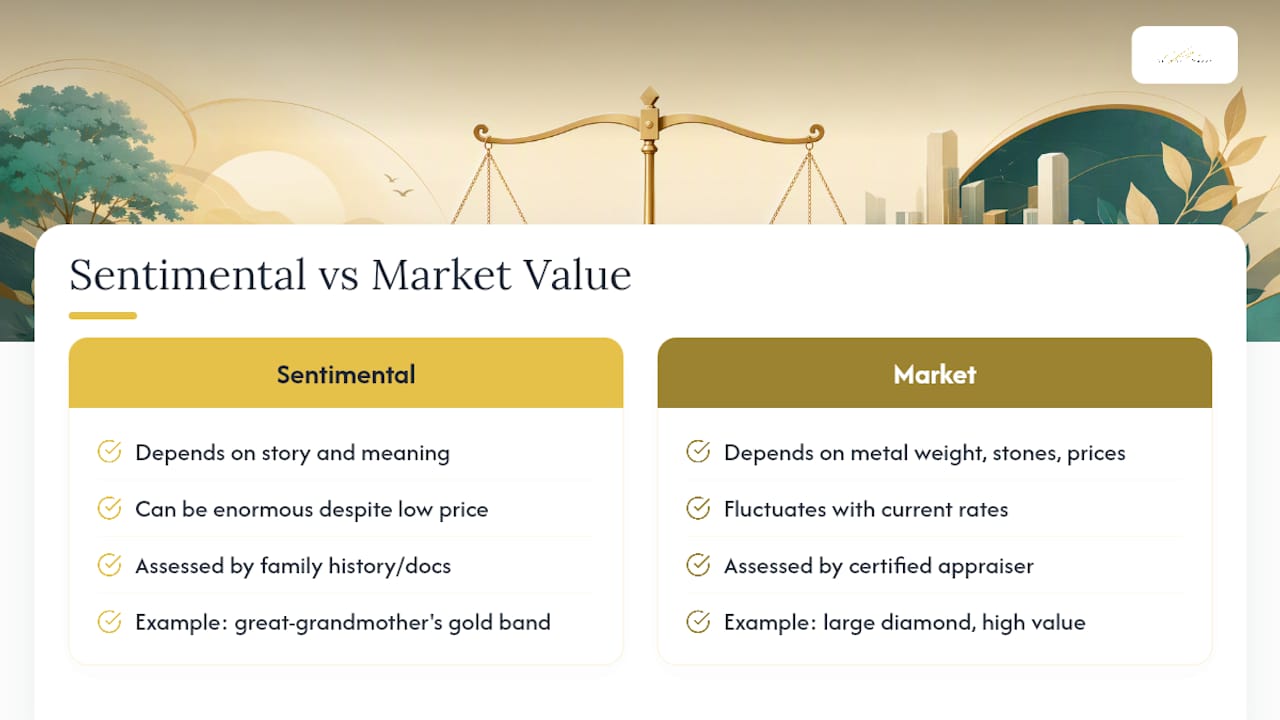
An heirloom’s sentimental value and its market value rarely move together, and confusing the two causes most family disputes. Market value depends on metal weight, stone quality, and current gold and gemstone prices, all of which fluctuate and can be assessed by a certified appraiser. Sentimental value depends entirely on story, meaning it can be enormous even when the market number is modest.
A simple gold band worn by a great-grandmother for 50 years might appraise for a few hundred dollars in raw materials, yet be the single most contested item in an estate because of what it represents. Conversely, a large diamond piece with real market value might carry little emotional weight if no one remembers whose it originally was.
Get a written appraisal for insurance and estate-planning purposes regardless of how you feel about the piece emotionally. This protects the object’s replacement value if it’s ever lost, stolen, or damaged, and it gives whoever inherits it a clear starting point rather than a guess. Keep the appraisal separate from the sentimental documentation, meaning the written story of who wore it and when, because families sometimes need one without the other. A piece with modest market value and a well-documented story often ends up meaning more to an heir than a more valuable piece with no history attached to it at all.
Passing Down Heirloom Jewelry Without Family Conflict
The biggest risk to an heirloom isn’t damage. It’s ambiguity about who gets it. Verbal promises made at holiday dinners rarely hold up when several people remember the conversation differently years later.
Put jewelry bequests in writing, ideally as a specific line item in a will or a separate letter of personal property that references the will. Many estate attorneys recommend a personal property memorandum specifically because it can be updated more easily than the full will itself if you change your mind about who gets what. Photograph each piece and attach a written description, since “grandma’s ring” means nothing to a probate court but a photo with a name attached settles it instantly.
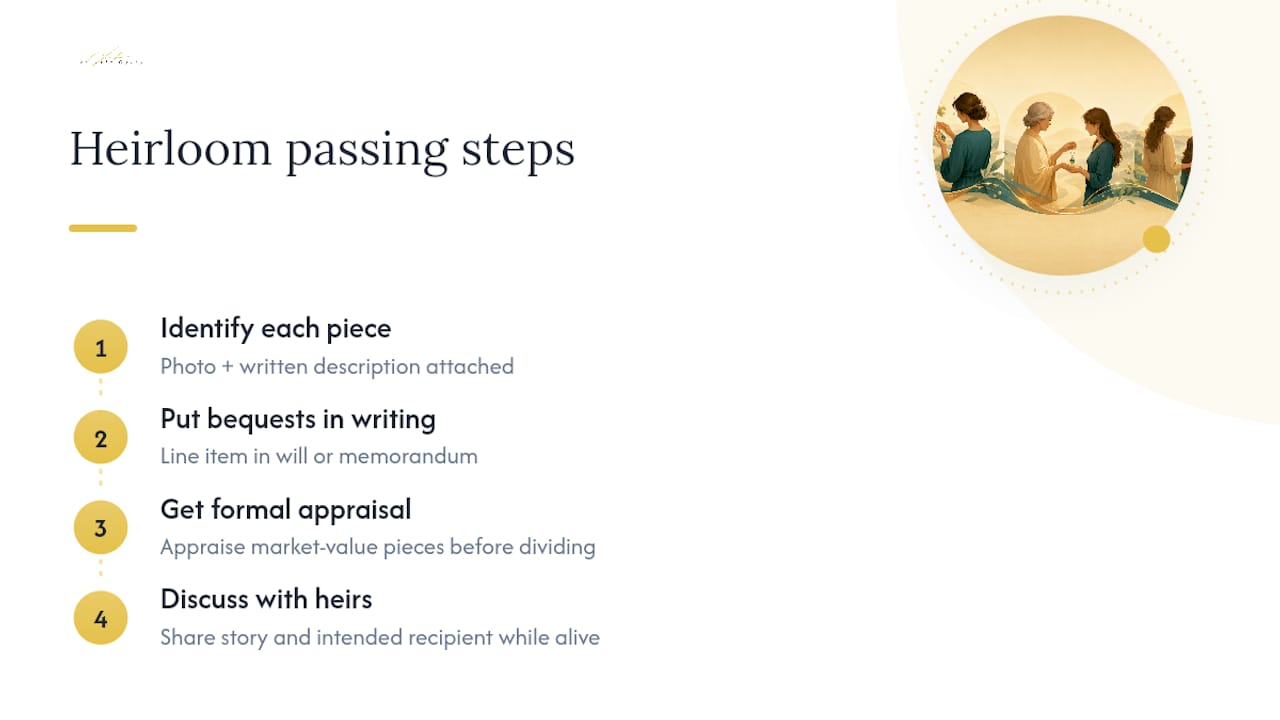
If you’re dividing several pieces among multiple heirs, consider letting each person choose one meaningful piece rather than assigning everything centrally, which tends to reduce resentment. For pieces with real market value, get a formal appraisal before dividing anything, so no one feels shortchanged by an uneven split based on guesswork.
Talk to the people who will eventually inherit these pieces while you’re still around to explain the story behind each one. A ring with a written note about who wore it and why carries far more weight passed down consciously than one discovered in a drawer after the fact, and it removes the guesswork that causes most family jewelry disputes in the first place.
A Note From Antonio on Craft, Ethics, and Legacy
Two decades of working with gold and Colombian emeralds taught me that a well-made piece outlasts the story of who bought it. Start building yours today.
— Antonio
How Antonio Guzzo Fine Jewelry Can Help You Start
Antonio Guzzo Fine Jewelry’s Signature Collection exists for exactly the ideas covered above: handcrafted pieces in solid gold, built with ethically sourced gemstones, and open to the kind of personalization that turns a purchase into a legacy piece.
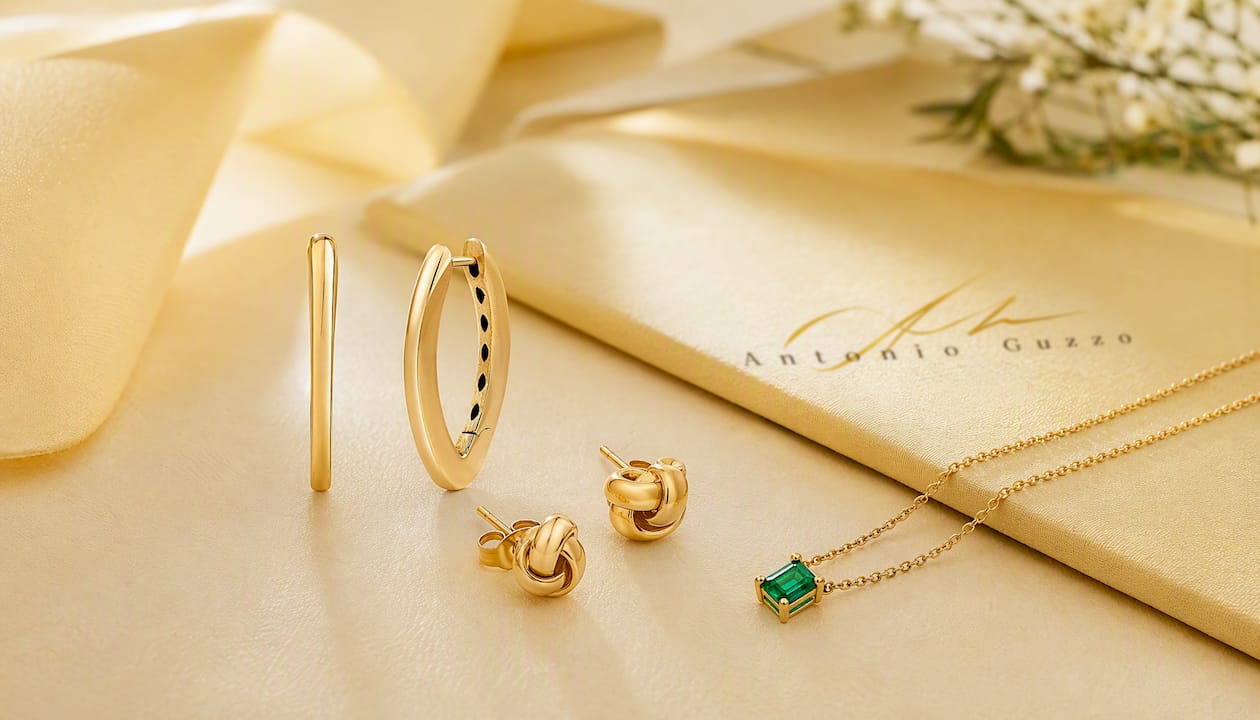
Three pieces work especially well as starting points. The 14K Yellow Gold Classic Polished Hoop Earrings give you a daily-wear anchor that won’t wear thin after a few years. The Knot Stud Earrings in 14K Solid Gold offer a compact, symbolic design (a literal knot, tied) that reads naturally as a keepsake. The 18K Gold Natural Emerald Necklace, set with a natural Colombian emerald, anchors an occasion-based heirloom for a wedding, anniversary, or milestone birthday. Browse the full earrings collection or explore the Signature Collection to book a personalization consultation and start the piece your family will be talking about in 30 years.
Sources
- Stuller trend report: vintage-inspired jewelry
- GIA: design inspiration from historic jewelry
- How to turn vintage jewellery into a family heirloom – Susannah Lovis
- The Imprint Pendant - Custom Handprint Pendant by Common Era
- Vintage inspired jewelry: the look without the fragility – Ezra Gems
FAQ
What makes jewelry an heirloom?
Craftsmanship, a recorded story, and durable construction make jewelry an heirloom. GIA design guidance confirms that construction quality matters more than age alone, so a newly made piece can qualify from day one.
What is the 2:1:1 rule in jewelry?
Definitions of this rule vary by source and context, and no single standard version applies across the jewelry industry, so it’s best treated as a design guideline specific to whoever mentions it rather than a universal formula.
What are some good ideas for family heirloom jewelry?
Strong options include signet rings, lockets, handwriting or fingerprint pendants, engraved medallions, and everyday hoops or studs built in solid 14K or 18K gold. Repurposing an inherited brooch into a pendant or resetting a loose stone into a modern band also preserves material history while making the piece wearable again.
What jewelry styles are trending right now?
Warm gold tones, pearls, and vintage-inspired metalwork with milgrain edges and filigree are leading current demand, paired with modern construction for everyday durability. Antonio Guzzo Fine Jewelry’s Signature Collection reflects this same pairing of vintage aesthetic with solid gold build quality.
Should I choose solid gold or plated jewelry for an heirloom?
Choose solid 14K or 18K gold for anything meant to last generations, since plated and hollow pieces wear through and lose shape far faster under regular use. Solid gold also holds up better to the resizing and remounting future owners will eventually need.