

Mohs 9 vs 7.5–8: Sapphire or Emerald for Your Ring?
Choose sapphire if everyday durability matters most: it rates 9 on the Mohs scale, the hardest gem after diamond. Choose emerald if you want the deepest, most collectible green on earth, understanding it needs gentler care and rates 7.5 to 8 on that same scale. Price for either stone depends less on species and more on the individual gem’s color, clarity, and origin. Some jewelers work primarily with natural Colombian emeralds set for protection, which can make emerald a realistic everyday choice when the setting is right.
TL;DR:
- Emeralds typically require more careful handling and protective settings due to their lower toughness and common internal fissures.
- Sapphires, rated 9 on the Mohs scale, are more scratch-resistant and better suited for daily wear, especially in active lifestyles.
- The price for both stones mainly depends on color saturation, origin, treatment level, and size, with top-grade examples reaching five or six figures per carat.
- Clarify treatment disclosure and obtain a lab report for high-value stones, as emeralds often have oil or resin fillings, while sapphires usually undergo heat treatment.
- Green sapphires can mimic emeralds visually while offering superior durability, making them an alternative for green gemstone enthusiasts.
Table of Contents
- Emerald vs Sapphire at a Glance
- What Is an Emerald?
- What Is a Sapphire?
- How Do Color and Appearance Actually Differ?
- Is Emerald or Sapphire More Durable for Daily Wear?
- How Do You Read Emerald and Sapphire Treatments?
- Which Gem Costs More: Emerald or Sapphire?
- How Do You Choose Between Emerald and Sapphire?
- Antonio’s Take on Choosing an Emerald That Lasts
- Emerald Rings Built for Real Wear
- Sources
- FAQ
Emerald vs Sapphire at a Glance
Both gems belong to what collectors call the “Big Three” colored stones alongside ruby, and both show up constantly in engagement rings and heirloom pieces. The fastest way to see how they differ is side by side.
| Factor | Emerald | Sapphire |
|---|---|---|
| Mineral | Beryl | Corundum |
| Typical color | Deep green (chromium/vanadium) | Blue is classic; also green, yellow, pink |
| Mohs hardness | 7.5 to 8 | 9 |
| Clarity | Usually included; oil/resin filling common | Often cleaner; heat treatment common |
| Best for | Statement pieces, pendants, earrings | Daily-wear rings, engagement rings |
| Budget expectation | Wide range; Colombian stones command a premium | Wide range; unheated stones command a premium |
If low maintenance is the top priority, sapphire is generally preferred. If you want a color no other gem replicates, emerald is worth the extra care.
What Is an Emerald?
Emerald is a variety of the mineral beryl, colored green by traces of chromium and sometimes vanadium, which contributes to its distinctive color. That chemistry is what separates emerald from aquamarine and morganite, its beryl cousins, and it produces the saturated green that has defined the stone since antiquity.
Almost every natural emerald carries what gemologists call a “jardin,” French for garden, referring to the web of internal inclusions visible to the naked eye. This isn’t a flaw in the usual sense. It’s part of the stone’s identity, and it can even function as a natural fingerprint, since lab-grown emeralds rarely replicate the same organic inclusion patterns.
Origin drives a lot of the price conversation. Colombian emeralds, especially from the Muzo and Chivor mines, are historically the benchmark for color. Zambian emeralds tend to run slightly bluer and often cleaner. Brazilian stones vary widely in quality. Because fissures are so common, most commercial emeralds receive oil or resin filling to improve clarity, a practice GIA’s emerald quality guidance treats as standard rather than deceptive, as long as it’s disclosed.
Before buying, ask:
- Is the stone natural, and what is its stated origin?
- What type of clarity enhancement was used, and how much?
- Does the seller have a lab report confirming both?
Pro Tip: Ask specifically whether the enhancement is described as “minor,” “moderate,” or “major” on the report, as it indicates potential future maintenance needs.
What Is a Sapphire?
Sapphire is corundum, the same mineral family as ruby, and any color other than red counts as sapphire. Blue is the benchmark that most buyers picture, but sapphire also occurs in green, yellow, pink, and violet, which is why a green sapphire can sometimes stand in for emerald visually while wearing far better day to day.
Color quality drives sapphire pricing more than clarity does, since inclusions are far less common than in emerald. Most sapphires on the market are heat treated to improve or stabilize color, a widely accepted practice that lowers cost compared to unheated stones. An unheated sapphire with strong color, particularly from Kashmir or Sri Lanka (Ceylon), can command a serious premium among collectors.
Corundum’s higher refractive index also gives sapphire more brilliance and a crisper sparkle than emerald, whose lower dispersion produces a softer, more velvety glow instead of a sharp fire.
Quick facts worth remembering:
- Sapphire’s hardness makes it very resistant to scratching in daily wear.
- Heat treatment is a common practice and generally accepted.
- Color saturation, not size alone, is the primary value driver.
How Do Color and Appearance Actually Differ?
Emerald’s green reads as saturated and slightly cool, often described as “vivid” when chromium content is high. Sapphire’s classic blue reads as deep and soft, the “velvety” quality collectors prize in fine Ceylon stones. Hue, tone, and saturation all shift the look: a stone can be technically green or blue and still look flat if the tone runs too dark or too light.
Setting changes perception more than most buyers expect. A halo of small diamonds makes a center stone look larger and boosts brightness by reflecting light back into the color. A solitaire lets the natural stone speak for itself, but it also exposes weak color more honestly. Table size and cut angle matter too: a shallow cut can wash out saturation, while a well-proportioned cut concentrates color toward the center.
Because emerald has a lower specific gravity than corundum, a one-carat emerald typically shows more face-up surface area than a one-carat sapphire, a detail GemFYI’s comparison notes as a practical reason emeralds can look larger for the same weight.
Green sapphire deserves a specific mention here. It can visually approach emerald’s color range while offering sapphire’s hardness, which makes it worth a look for anyone drawn to green but nervous about durability.
- Compare stones under daylight, incandescent light, and jewelry-store LED light before deciding.
- View against a neutral gray or white background, never a colored fabric.
Pro Tip: Photograph the stone against your own hand in natural window light. Store lighting is engineered to flatter color, and it can hide weak saturation you’d notice at home.
Is Emerald or Sapphire More Durable for Daily Wear?
Sapphire wins this comparison decisively. GIA rates sapphire at 9 on the Mohs scale, versus 7.5 to 8 for emerald, and that gap matters more in practice than the numbers suggest. Mohs hardness measures scratch resistance, not overall toughness, and emerald’s real weakness is fracture toughness. Its dense inclusion network gives fissures a path to travel, so a hard knock is more likely to chip an emerald than an equally hard knock against a sapphire.
Mohs hardness: sapphire = 9, emerald = 7.5 to 8. GIA notes this gap directly affects scratch resistance, though toughness against chipping depends on the stone’s individual inclusion pattern as much as its hardness rating.
For everyday rings, protective settings matter more with emerald than with sapphire. Bezel settings, which wrap metal around the stone’s edge, guard against chips far better than exposed prong settings. Sapphire tolerates prong settings and daily wear with little worry, which is one reason Gemslore’s buying guidance points people toward sapphire or ruby when low maintenance is the priority.
Care basics worth knowing:
- Never clean a filled emerald in an ultrasonic cleaner; the vibration can worsen existing fissures.
- Use warm water and a soft brush for emeralds, and remove the ring before heavy manual work.
- Sapphire tolerates ultrasonic cleaning and most standard jewelry cleaning methods.
- Insure any high-value stone regardless of hardness rating.
How Do You Read Emerald and Sapphire Treatments?
Treatment disclosure is where buyers get burned if they don’t ask the right questions. GIA’s emerald guidance recommends that clarity enhancement appear on the lab report as none, minor, moderate, or major, since a “major” enhancement can mean the stone eventually needs re-treatment to maintain its appearance.
Sapphire treatment works differently. Heat treatment improves color and clarity and is considered standard, with minimal impact on durability. Diffusion treatment, which adds color-causing elements to the surface layer, is a deeper intervention that should always be disclosed and typically lowers value compared to heat-only or unheated stones.
To verify what you’re buying:
- Ask the seller whether the stone is treated and how, to understand treatment impact.
- Request a lab report from GIA or a comparable gemological lab.
- Confirm the report states the degree of enhancement, not just its presence.
- For emerald, ask whether inclusions are “open” (surface-reaching) or contained within the stone, since surface-reaching fissures are the primary vulnerability point during setting.
Pro Tip: A seller who hesitates to produce a lab report on a stone over one carat is a signal to walk away, not a detail to overlook.
Which Gem Costs More: Emerald or Sapphire?
Neither gem is categorically more expensive. Sotheby’s collector guide to the Big Three makes clear that price hinges on the individual stone’s color saturation, transparency, origin, size, and treatment level, and top examples of either species can outprice each other depending on quality.
For emerald, Colombian origin with minimal enhancement pushes price up fast. For sapphire, unheated Kashmir or Ceylon stones with strong blue saturation do the same. A commercially graded stone of either type, treated and modest in size, might run a few hundred dollars per carat. A premium stone with better color and minor treatment moves into four figures per carat. Investment-grade stones, meaning large, unheated or minimally enhanced gems with top color and clean provenance, can reach five and six figures per carat at auction.
- Color saturation is usually the single biggest price lever for both gems.
- Origin premiums are real but require lab confirmation, not just a seller’s word.
- Size increases price faster than linearly once a stone crosses roughly two carats.
- Independent lab documentation and provenance records matter more at higher price points, not less.
How Do You Choose Between Emerald and Sapphire?
Run the decision through two questions: how much does color matter to you, and how much does daily durability matter?
If color and collectibility outrank convenience, emerald is the answer. Nothing else on the market matches its exact green, and a well-set emerald can last generations with reasonable care. If you want to wear a ring daily without a second thought, sapphire is the more forgiving choice, especially in an active lifestyle.
Before you buy either stone, run this checklist:
- Confirm treatment disclosure in writing, not just verbally.
- Request a lab report from GIA or an equivalent lab for any stone over roughly half a carat.
- Choose a protective setting, bezel or half-bezel for emerald, standard prongs are fine for sapphire.
- Ask about the seller’s return and repair policy before finalizing.
- Insure the piece once it’s set, particularly for natural emerald.
Lab-grown sapphires and emeralds are worth a look if budget or design flexibility matters more than natural origin. They offer the same optical properties at a fraction of the cost, though they won’t carry the collector value or the natural inclusion “fingerprint” that gives a wild-formed stone its individual character.
Pro Tip: If you love emerald green but worry about daily wear, ask about a green sapphire instead. You get a comparable color family with sapphire’s 9 Mohs hardness.
Antonio’s Take on Choosing an Emerald That Lasts
Natural Colombian emerald earns its reputation the hard way. I recommend it when a buyer wants a stone with real character, not a flawless void of color, and understands that a bezel or trilogy-style setting does more for its longevity than any cleaning routine. Handcrafted settings from our Signature Collection are built around that reality. Set the expectation early: emerald rewards care, not neglect, and that tradeoff is worth it for the right buyer.
— Antonio
Emerald Rings Built for Real Wear
Natural Colombian emeralds can be set in ways collectors want them protected, not just displayed. Unlike mass-market pieces that prioritize a big stone over a secure setting, some designs start with how the emerald will hold up over years of wear.
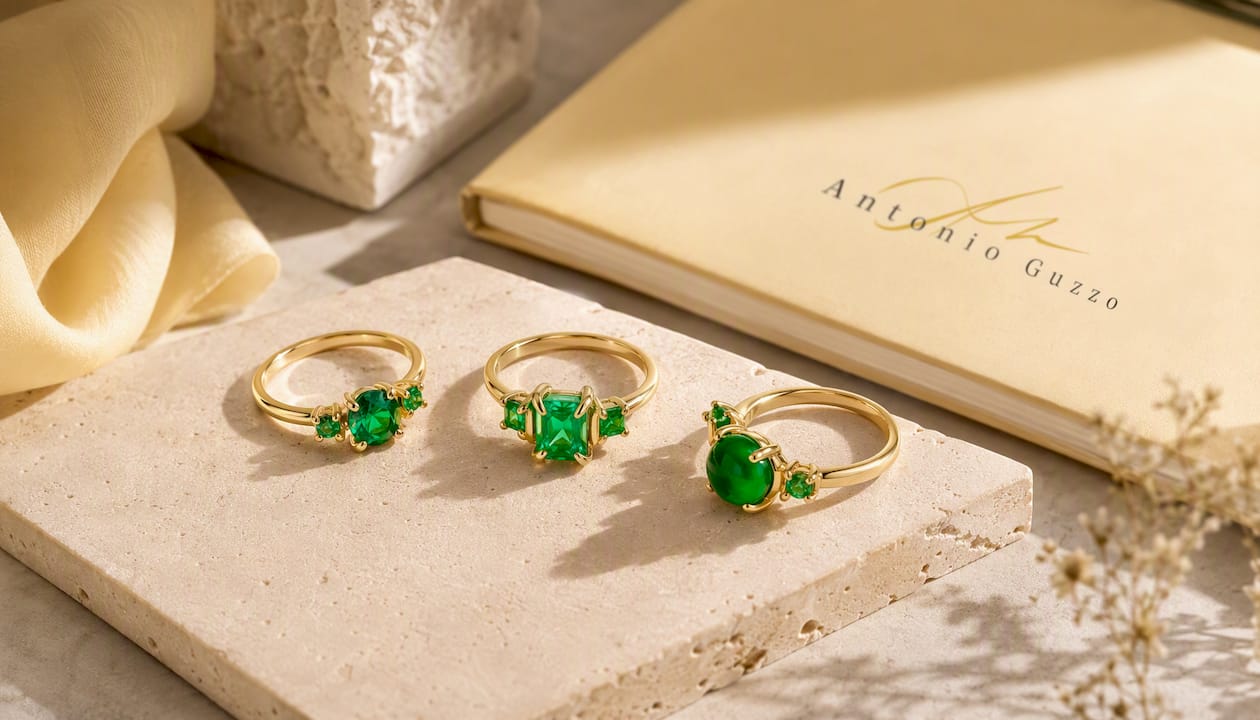
The Exquisite 18K Trilogy Emerald Ring pairs a protective three-stone layout with handcrafted Italian detailing, ideal for buyers who want emerald’s color without exposing a single center stone to every knock. The 18K Yellow Gold Natural Emerald Trilogy Ring offers the same trilogy structure in warm yellow gold, a setting choice that flatters emerald’s green while adding metal coverage around each stone. For buyers who specifically want traceable Colombian origin, the emphasizes natural, ethically sourced stones with documented provenance.
Some jewelers offer free shipping, and pieces may be handcrafted rather than mass-produced. Browse the emerald ring collection and pick the setting that matches how you’ll actually wear it.
Sources
- GIA (Gemological Institute of America)
- Sotheby’s — Ruby, Sapphire or Emerald? A collector’s guide to the “Big Three” gemstones
Consult a lab report and a gemologist directly before committing to any high-value purchase.
FAQ
Is Emerald Better Than Sapphire?
Neither is universally better. Sapphire wins on durability with a Mohs hardness of 9 versus emerald’s 7.5 to 8, but emerald offers a green color no other natural gem replicates.
Do Emeralds Cost More Than Sapphires?
Not by species alone. Price depends on individual stone quality, color saturation, transparency, origin, and treatment level, and top examples of either gem can outprice the other.
What Are the Big Three Precious Gems?
The “Big Three” colored gemstones are ruby, sapphire, and emerald, the traditional benchmark stones in the colored gemstone market.
Why Can’t You Wear Emeralds Every Day?
Emerald’s dense inclusion pattern makes it more prone to chipping than sapphire, and many emeralds carry oil or resin fillings that ultrasonic cleaning or hard impacts can damage. A protective setting like a bezel makes daily wear far more realistic.