

14K/18K Gold Bracelet Sizing: Add 1/2 Inch for Comfortable Fit
Measure your wrist circumference just below the wrist bone, at the exact spot where you’d wear the bracelet, using a soft tape or a piece of string. Add about 1/4 to 1/2 inch for a snug to comfortable fit, or 3/4 to 1 inch if you like bracelets loose. For bangles, measure your hand across the knuckles instead of the wrist. If your number lands between two standard sizes, it is recommended to size up.
TL;DR:
- Measure your wrist just below the wrist bone using a tape, string, or printable strip, and add 1/4 to 1 inch based on preferred fit.
- For bangles, measure across the knuckles and convert the circumference to diameter, rounding up to the next size for comfort.
- Sizing should account for bracelet style: heavier chains and charms require extra length, while cuffs and bangles are more forgiving.
- Sizing up is recommended when between two sizes, especially for chain and tennis bracelets that need to drape naturally.
- Many jewelers, including Antonio Guzzo Fine Jewelry, provide exact lengths and offer guidance for custom sizing to ensure comfort and longevity.
Table of Contents
- How Do You Measure Your Wrist for a Bracelet?
- How Do You Convert Wrist Measurements to a Bracelet Size?
- Does Bracelet Sizing Change by Style?
- What Should You Do If You’re Between Two Sizes?
- Antonio Guzzo Fine Jewelry’s Guidance for Fine Gold Bracelets
- A Note From Antonio on Fit and Heirloom Jewelry
- Where to Find Your Size in the Antonio Guzzo Collection
- Sources
- FAQ
How Do You Measure Your Wrist for a Bracelet?
You need one of three tools: a soft fabric measuring tape, a piece of string or paper with a ruler, or a printable sizing strip. Any of them will get you an accurate wrist circumference in under a minute.
Here’s the method that works whether you’re sizing a chain, a cuff, or a bangle:
- Wrap the tape (or string) around your wrist just below the wrist bone, in the spot where a bracelet naturally sits.
- Keep the tape snug against your skin but not tight enough to indent it. If you’re using string, mark where it overlaps, then lay it flat against a ruler.
- Measure your non-dominant wrist if the two differ slightly. Most people’s wrists vary by a fraction of an inch between hands.
- Take the measurement twice. Wrapping the tape around your wrist at the exact spot you’d wear the piece is the step people rush most, and rushing it is the top cause of a bracelet that’s too tight or too loose.
- Write the number down immediately. Wrist measurements are easy to second-guess after the fact.
If you’re sizing a bangle instead of a clasp bracelet, skip the wrist and measure your hand. Fold your fingers together and bring your thumb in to touch the base of your pinky, then wrap the tape around the widest part of your knuckles. That number is your hand circumference, which you’ll convert to an inner diameter in the next step.
Printable sizing strips work well if you don’t own a tape measure, but only if you print them correctly. Printable sizing kits reduce measurement error significantly, but only when printed at 100% scale rather than “fit to page,” which shrinks the ruler markings just enough to throw off your result.
Pro Tip: If you already own a bracelet that fits the way you like, skip the wrist entirely. Lay it flat on a ruler and measure end to end. Comparing an existing piece that fits often gets you to the right number faster than measuring your own wrist.
How Do You Convert Wrist Measurements to a Bracelet Size?
Sellers list bracelet dimensions two different ways: as a circumference (the total length that wraps around your wrist) or as an inner diameter (the straight-line width across a bangle’s opening). If a listing gives you diameter and you measured circumference, or vice versa, the math is simple: diameter multiplied by pi (3.14159) gives you circumference, and circumference divided by pi gives you diameter.
Once you have your wrist number, add varying amounts of length depending on the desired fit: a small addition for a snug fit, a moderate addition for comfortable fit, and a larger addition for a loose, draped fit.
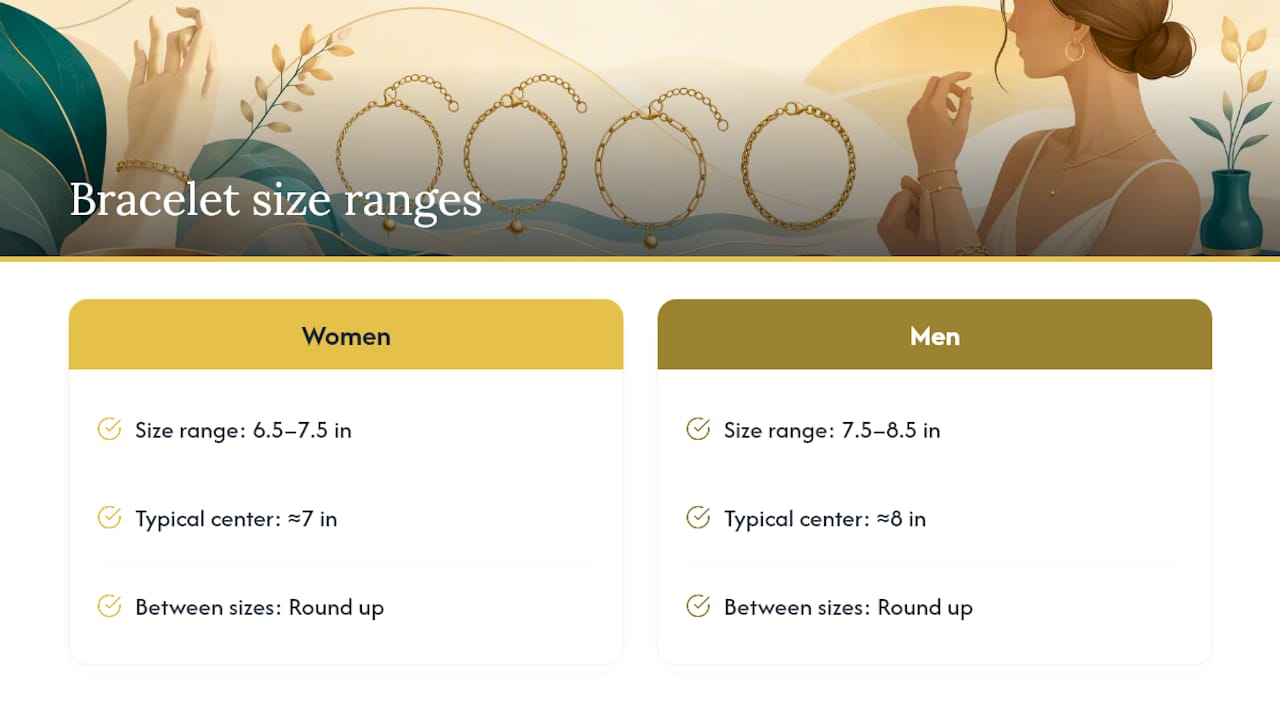
For reference, women’s bracelets commonly run around 6.5 to 7.5 inches, centering near 7 inches. Men’s pieces typically run 7.5 to 8.5 inches, centering near 8 inches. These are starting points, not universal rules. If your calculated size falls between two options a seller offers, round up rather than down. A slightly loose bracelet is comfortable; a slightly tight one is not wearable at all.
Does Bracelet Sizing Change by Style?
Yes, and this is where a lot of buyers get tripped up. The right measurement and the right amount of wearing ease depend entirely on the bracelet’s construction.
- Clasp and chain bracelets: Use wrist circumference plus wearing ease. Heavier chains or pieces with charms should size up slightly, since added weight can restrict comfortable movement at a snug length.
- Bangles: Use hand knuckle circumference, converted to diameter, then rounded up to the next available size so it clears your knuckles without a struggle.
- Cuffs: Use wrist circumference and aim for a slightly snug fit, since most cuffs have some flexibility built into the metal itself. Check whether the design is adjustable before assuming one size fits your exact number.
Your wrist also isn’t a fixed number throughout the day. Wrists swell slightly with heat, activity, and salt intake, so measuring first thing in the morning gives a more honest baseline than measuring after a workout or a hot afternoon.
What Should You Do If You’re Between Two Sizes?
Sizing up is almost always the safer call, particularly for chains and tennis bracelets that need to hang naturally rather than sit tight against the skin. A cuff or bangle is more forgiving because those styles are designed with some flexibility already.
If a size still doesn’t feel right after you receive it, three adjustment options generally solve the problem:
- Link removal or addition. Many chain bracelets can have links added or removed, though this sometimes affects a clasp’s original tension.
- Extenders. A small chain extension gives you two or three sizing options on one bracelet without permanent changes.
- Custom sizing or clasp adjustment. A jeweler can shorten or lengthen a piece directly, which works well for fine gold designs where link removal isn’t practical.
Before buying, ask customer service three questions: can this specific design be resized, does resizing affect the warranty, and what size does the brand recommend for this style.
Antonio Guzzo Fine Jewelry’s Guidance for Fine Gold Bracelets
Fit matters more with fine gold than with costume pieces, because a solid 14K or 18K bracelet carries real weight and is meant to last for decades, not seasons.
- For link and chain bracelets, a comfortable fit range is generally recommended: roughly 1/2 inch beyond your wrist measurement, since gold links drape better with a small amount of give.
- Heavier designs, including oval link styles, often benefit from sizing up slightly to keep the weight from pulling the clasp against the wrist bone.
- Product pages often list the bracelet’s total length so you can compare it directly against your measured wrist number before ordering.
- Material and construction also affect how a piece should fit. Our comparison of fine jewelry and fashion jewelry explains why solid gold pieces hold their shape and sizing far better over years of wear than plated alternatives.
A Note From Antonio on Fit and Heirloom Jewelry
A bracelet you plan to hand down needs to fit right the day you receive it, not just look right in a photo. I’ve seen how a quarter inch of misjudged ease turns a piece someone loves into one that sits in a drawer. Precise sizing is what keeps a gold bracelet in daily rotation for years instead of becoming a special-occasion piece worn twice a year. If your measurement falls between our standard sizes, reach out to us directly. We’ll walk through the numbers with you before you order.
— Antonio
Where to Find Your Size in the Antonio Guzzo Collection
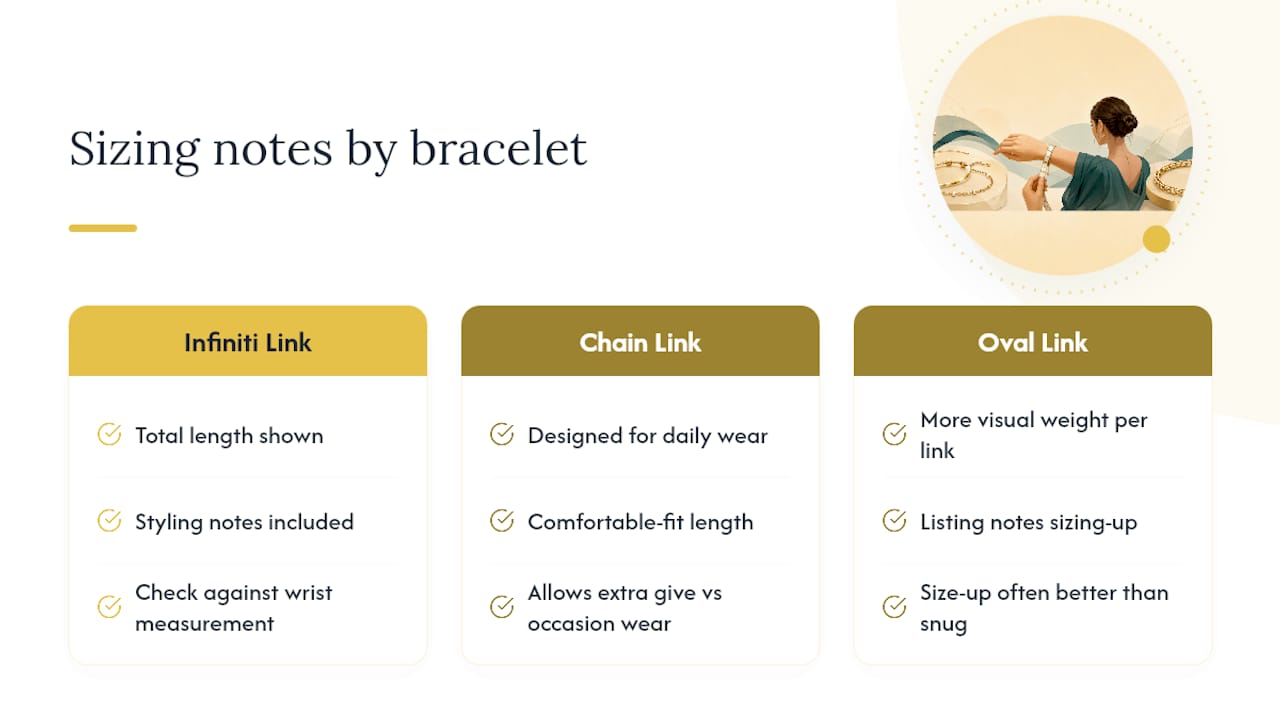
Antonio Guzzo Fine Jewelry lists exact lengths on every product page, so you can match your measurement to the piece before you buy rather than guessing. The 18K Gold Infiniti Link Bracelet shows total length alongside styling notes, which makes it easy to check against your wrist number plus wearing ease.
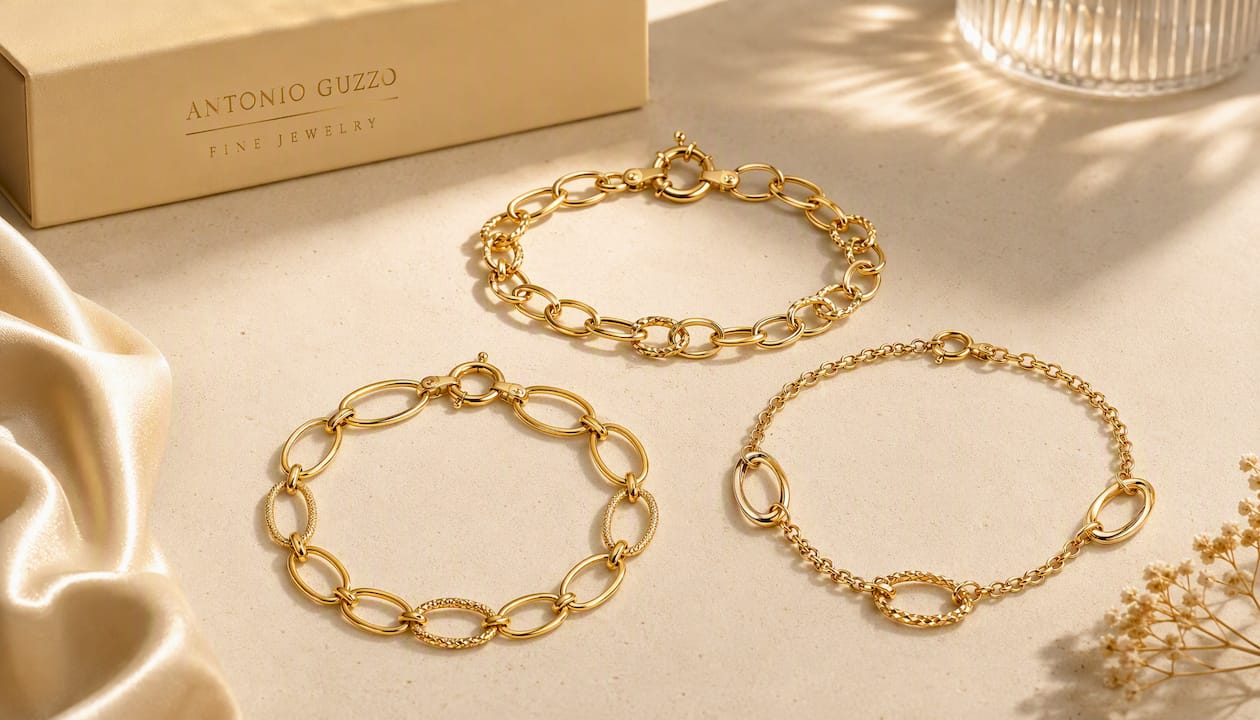
The Gold Chain Link Bracelet built for daily wear is designed with a comfortable-fit length in mind, since a piece worn every day needs a bit more give than an occasion-only bracelet. The 18K Gold Oval Link Bracelet carries more visual weight per link, so its listing includes notes on why a size-up often suits this design better than a snug fit.
Shipping policies vary by retailer, and some teams offer custom sizing consultation before checkout. Browse the full luxury bracelet collection or contact us directly with your wrist measurement, and we’ll help you land on the right size the first time.
Sources
For a second opinion on your numbers, Jewelers Mutual’s sizing guide and James Avery’s bracelet size guide both offer printable references.
- How to measure bracelet size | Jewelers Mutual
- How to Measure Wrist Size: 10 Steps (with Pictures) - wikiHow
FAQ
What Measurement Do I Need for a Bracelet Size Guide?
Measure your wrist circumference just below the wrist bone using a soft tape or string, then add 1/4 to 1 inch depending on how snug or loose you want the fit.
How Much Should I Add for a Comfortable Fit?
Add about 1/2 inch to your wrist measurement for a comfortable, everyday fit; add 1/4 inch for snug and 3/4 to 1 inch for a loose, draped look.
What’s the Standard Bracelet Length for Women and Men?
Women’s bracelets commonly run around 7 inches, while men’s bracelets typically run closer to 8 inches, though exact standards vary by seller and design.
How Do I Measure My Hand for a Bangle Instead of My Wrist?
Fold your fingers together with your thumb touching the base of your pinky, then measure around the widest part of your knuckles and convert that circumference to an inner diameter.
Should I Size Up If I’m Between Two Sizes?
Yes, sizing up is generally the safer choice, especially for chains and tennis bracelets that need room to drape rather than sit tight against the wrist.
Does Antonio Guzzo Fine Jewelry Offer Help With Custom Sizing?
Yes, Antonio Guzzo Fine Jewelry lists exact lengths on each product page and offers direct contact for customers who need custom sizing guidance before ordering.