

U.S. Buyers: Colombian vs Zambian Emeralds, Get a Lab Report First
Colombian emeralds win on color, showing the warm, saturated green that most people picture when they hear the word “emerald.” Zambian emeralds win on clarity and value, often appearing cleaner to the eye at a lower price per carat. If bright, classic green is your priority, Colombian stones typically deliver it; if you want more clarity for your money, Zambian stones usually win. Either way, ask for an independent lab report before you buy.
TL;DR:
- Most Colombian emeralds display a warm, bright green with a yellowish undertone, while Zambian emeralds tend to be cooler, bluer, and more transparent.
- A lab report is essential to verify origin, treatment disclosure, carat weight, and clarity, especially since visually similar Zambian and Colombian stones can result from overlapping chemical sources.
- Colombian emeralds often show characteristic three-phase inclusions and are usually oil-treated, with a reputation rooted in centuries of historical prestige.
- Zambian stones generally offer better clarity for the price, with fewer inclusions and a deeper blue-green hue due to higher iron content, but smaller sizes are more common.
- Buyers should focus on documentation and testing rather than origin claims alone, as origin verification remains challenging and many stones are treated or synthetically produced.
Table of Contents
- Colombian vs. Zambian Emerald: Quick Comparison
- What Makes Colombian Emeralds Look the Way They Do?
- What Makes Zambian Emeralds Different From Colombian?
- Colombian vs. Zambian Emerald: Side-by-Side Buying Factors
- How Should You Actually Buy an Emerald?
- Where Antonio Guzzo Fine Jewelry Fits Into This Comparison
- Why Have Colombian Emeralds Held Cultural Prestige for So Long?
- Why Is Emerald Sourcing Still Hard to Verify?
- How Do You Spot a Fake or Treated Stone?
- An Editorial Note on Color, Clarity, and Choosing Well
- Ready to Choose Your Colombian Emerald?
- Sources
- FAQ
Colombian vs. Zambian Emerald: Quick Comparison
Before getting into the geology and lab science, here’s the shorthand version most buyers actually need at the counter or checkout screen.
- Color: Colombian emeralds run warm and bright, often with a slightly yellow undertone in the green. Zambian emeralds trend cooler and bluer, sometimes described as “forest green.”
- Clarity: Zambian material is often cleaner in the trade, with fewer visible inclusions. Colombian stones commonly show three-phase inclusions and internal texture that traders sometimes call the stone’s “fingerprint.”
- Price and prestige: Colombian emeralds usually carry a price premium tied to name recognition and historical reputation. Zambian emeralds tend to offer more size and clarity per dollar.
- Treatments: Nearly all emeralds from both origins are oiled to some degree to improve apparent clarity. The question isn’t whether a stone was treated. It’s whether the seller told you.
Buying checklist: insist on a lab report, get treatment disclosure in writing, and confirm the seller’s return policy before you pay.
What Makes Colombian Emeralds Look the Way They Do?
Colombian emeralds come primarily from three deposits: Muzo, Chivor, and Coscuez, all formed through a hydrothermal process, unique among major emerald sources. Unlike most emeralds worldwide, which form in metamorphic or pegmatite environments, Colombian emeralds crystallized in black shale beds where hot mineral-rich fluids moved through fractures over millions of years. That geological quirk matters because it’s part of why Colombian green looks different from green mined anywhere else.
The color itself comes down to chemistry. Colombian emeralds are typically rich in both vanadium and chromium, the two trace elements responsible for that bright, saturated green with a warm undertone that collectors call “classic emerald color.” Most other emerald deposits rely on chromium alone, which tends to produce a slightly different, often cooler tone.
Colombian emeralds by the numbers: Stones from Muzo, Chivor, and Coscuez are known in gemological literature for characteristic three-phase inclusions, which are tiny cavities containing liquid, gas, and a solid crystal all at once. Trade professionals also describe a rolling, oily look inside some Colombian stones called “gota de aceite,” or oil drop, that acts as a visual signature of origin.
Those inclusions aren’t flaws in the usual sense. They’re part of what makes a Colombian emerald identifiable, even if they do reduce clarity grade compared to a cleaner stone. Buyers chasing pure transparency might find that frustrating. Buyers who understand emeralds tend to see it as character.
Nearly every Colombian emerald on the market has been oiled, usually with cedarwood oil, to fill surface-reaching fractures and improve the stone’s apparent clarity. This is standard practice and not a red flag by itself, but reputable sellers disclose it rather than let you find out later. The combination of documented origin, that specific color chemistry, and centuries of market reputation is why Colombian material commands a price premium over stones of similar visual quality from other sources.
What Makes Zambian Emeralds Different From Colombian?
Zambia’s emerald story starts with the Kafubu area, a schist-hosted deposit that has supplied the majority of Zambian material reaching international markets. A newer source, the Musakashi deposit, has drawn attention in gemological circles for producing stones that look and test surprisingly close to Colombian emeralds.
Kafubu emeralds tend to carry higher iron content than their Colombian counterparts, and that iron is the reason Zambian green often reads cooler and bluer rather than warm and yellow-toned. Iron also tends to mute a stone’s brightness slightly compared to chromium-and-vanadium-driven color, which is part of why Zambian material sometimes gets described as “darker” green rather than “brighter” green.
Notable inclusion types in Zambian emeralds:
- Mica flakes, which can appear as small reflective platelets under magnification
- Amphibole needles, thin fibrous crystals embedded in the stone
- Fewer three-phase inclusions than typical Colombian material, contributing to a cleaner trade appearance
The Musakashi surprise: SSEF research on emeralds from the Musakashi deposit in Zambia found that this material clusters chemically very close to Colombian emeralds in multi-element analysis, while Kafubu stones remain distinctly iron-enriched and separate from both groups. That overlap means a visual inspection alone, even by an experienced eye, can no longer reliably separate some Zambian stones from Colombian ones.
For buyers, the implication is straightforward: an origin claim without lab backing is a claim, not a fact. If a seller tells you a stone is Colombian and the price reflects that, ask for the paperwork that proves it. Musakashi material also tends to appear in smaller sizes, typically in the 1 to 5 carat range for faceted stones, though larger pieces do occasionally surface.
Colombian vs. Zambian Emerald: Side-by-Side Buying Factors
Here’s how the two origins stack up once you get past the general reputation and into what actually shows up in a jeweler’s loupe or a lab report.
- Color: Colombian leans warm, bright, slightly yellow-green. Zambian leans cool, deep, slightly blue-green.
- Clarity: Zambian often grades cleaner due to fewer three-phase inclusions. Colombian frequently shows more internal texture, which trade buyers read as an origin cue rather than a defect.
- Treatment: Both origins are commonly oiled. Disclosure quality matters more than origin here.
- Price: Colombian carries a historical prestige premium at comparable quality. Zambian delivers strong size and clarity per dollar spent.
- Typical sizes: Colombian stones span a wide range from small accent stones to large collector pieces from Muzo and Chivor. Zambian faceted stones, especially from Musakashi, tend to run smaller on average, with larger pieces less common.
Three buyer types tend to fall out of this comparison naturally. The classic color buyer wants the traditional bright green look for an engagement ring or heirloom piece and usually gravitates toward Colombian material, even at a premium. The clarity and value buyer cares more about a clean-looking stone at a reasonable price per carat and often finds Zambian emeralds hit that mark efficiently. The collector or investor cares less about which country and more about documentation, rarity, and lab-confirmed characteristics, sometimes picking Colombian for resale reputation and sometimes picking a well-documented Zambian stone for its own merits.
One thing that trips up a lot of first-time buyers: certification and cut quality can matter more to final price than origin alone. A poorly cut Colombian stone with heavy oiling can sell for less than a well-cut, lightly treated Zambian stone of similar carat weight.
How Should You Actually Buy an Emerald?
Insisting on documentation isn’t optional caution here. It’s the entire ballgame. A legitimate lab report from GIA, SSEF, or an equivalent gemological laboratory should state carat weight, clarity characteristics, treatment status, and, when tested, a geographic origin opinion.
- Ask the seller directly whether the stone has been oiled, and get the answer in writing.
- Request the lab report itself, not just a verbal summary of what it says.
- Confirm the report names an actual laboratory, not an in-house gemologist with no outside accreditation.
- Check the return policy before paying, especially for online purchases.
- Compare price against carat weight, clarity, and documented origin together, not any single factor alone.
Rough pricing tends to move in tiers: lightly included, well-colored Colombian stones sit at the top of the market, moderately included stones of either origin occupy the middle, and heavily included or heavily treated stones sit lowest regardless of country of origin.
Pro Tip: Ask specifically whether the treatment is a standard light oiling or a more significant clarity enhancement. The difference affects both value and long-term care, since heavily filled stones need gentler cleaning.
Emeralds sit around 7.5 to 8 on the Mohs hardness scale, softer than sapphire or diamond, so avoid ultrasonic cleaners and get your setting checked annually if you wear the piece daily.
Where Antonio Guzzo Fine Jewelry Fits Into This Comparison
Some jewelers source natural Colombian emeralds for collections built around the idea that a gemstone should carry a story, not just a specification sheet. Pieces may be handcrafted using sustainable practices and solid gold, with customers potentially able to request documentation on sourcing and treatment before purchase.
- Classic Colombian Emerald Stud Earrings in 18K Gold, suited to buyers who want everyday bright green without a large center stone.
- 18K Yellow Gold Colombian Emerald Stud Earrings, a warm-metal pairing that plays up the classic yellow-green Colombian hue.
- Classic Colombian Emerald Ring in 18K Gold, aimed at buyers seeking a statement piece with the traditional Colombian color at its center.
Customers can request lab documentation and review return details before finalizing an order.
Why Have Colombian Emeralds Held Cultural Prestige for So Long?
Colombian emeralds have carried outsized cultural weight since well before the modern gem trade existed. Indigenous cultures in the region, including the Muzo people themselves, mined and traded emeralds for centuries before Spanish colonizers arrived and began exporting the stones to European royal courts in the 1500s. That early export history is part of why “emerald” and “Colombia” became linked in the public imagination long before modern mining data existed.
European monarchies, Mughal emperors, and later Hollywood’s golden age all played a role in cementing Colombian green as the reference point for the word “emerald” itself. When someone says a stone has “emerald green” color, they’re usually describing the Colombian ideal, whether they realize it or not.
Zambian emeralds carry a very different, much shorter cultural story. Commercial mining at Kafubu didn’t really take off until the 1970s, meaning Zambian material has spent decades building trade reputation rather than centuries building royal provenance. That’s not a knock on the stones themselves. It’s simply a different kind of trust to earn, built on consistency of supply and clarity rather than historical prestige.
For a lot of buyers, that history genuinely shapes the purchase decision. Someone buying an heirloom engagement ring may lean Colombian specifically because of that centuries-deep association. Someone buying a modern statement piece with less emotional weight tied to tradition may not care about that history at all, and Zambian material’s practical advantages become the deciding factor instead.
Why Is Emerald Sourcing Still Hard to Verify?
Emerald mining, unlike diamond mining, has never had a global tracking system equivalent to the Kimberley Process. That gap matters more than most buyers realize, because it means origin claims in the emerald trade often rely on dealer reputation rather than any centralized verification system.
Colombian mining involves a mix of large formal operations and smaller independent miners, particularly around Muzo and Coscuez, which creates a supply chain with multiple hand-offs before a rough stone reaches a cutter. Zambian mining, by contrast, is more consolidated around a smaller number of larger operations at Kafubu, which in some ways simplifies tracing but doesn’t eliminate the need for lab verification once stones enter international trade.
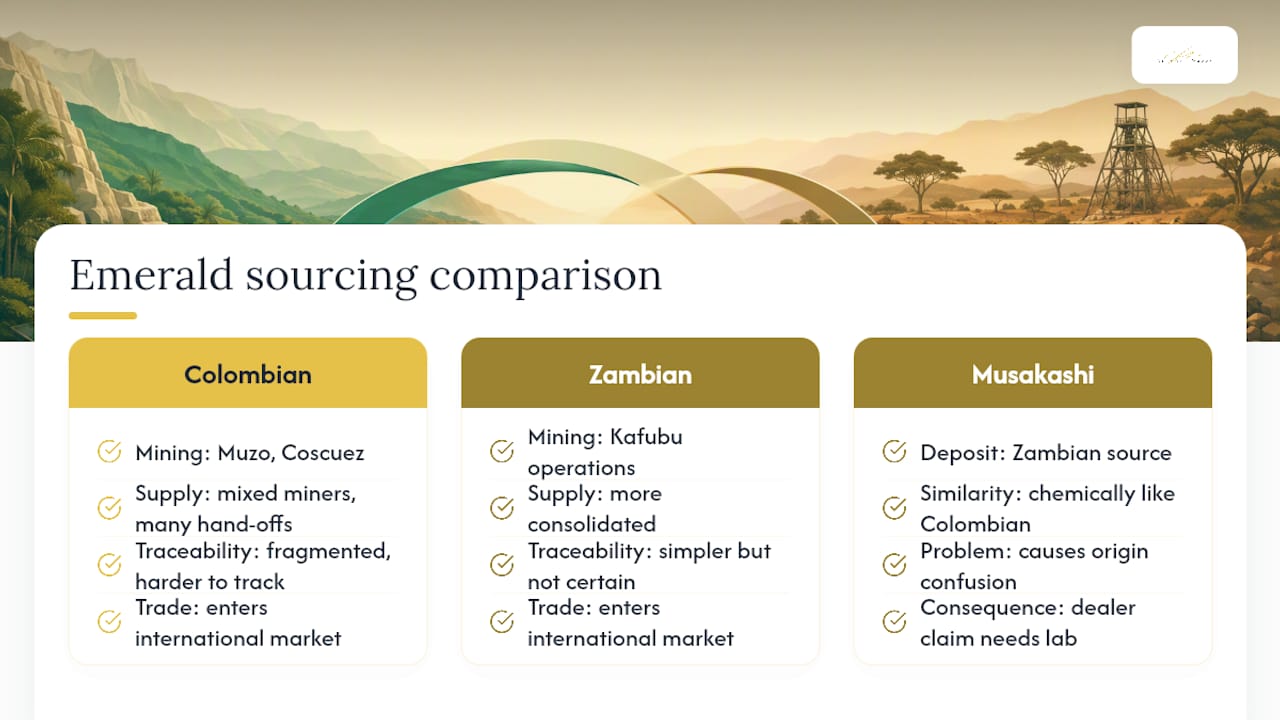
The Musakashi overlap problem makes this even more pressing. Because that Zambian deposit can produce stones that chemically resemble Colombian material, a dealer claim of “Colombian origin” on a visually similar stone needs lab confirmation, not just trust in the seller’s word. This isn’t a reason to distrust the entire market. It’s a reason to treat documentation as part of the purchase, the same way you’d treat a title search when buying property.
Buyers researching Colombian emerald quality or Zambian emerald characteristics online will find plenty of dealer claims and comparatively few third-party verifications. That gap is exactly why insisting on a lab report isn’t excessive caution. It’s the only way to actually confirm what you’re buying.
How Do You Spot a Fake or Treated Stone?
Synthetic emeralds, grown in a lab through flux or hydrothermal methods, have existed for decades and can fool an untrained eye at first glance. The giveaway for Colombian-style synthetics is often the absence of the specific three-phase inclusions and oil-drop texture that natural Muzo and Chivor stones typically show. Lab-grown stones tend to look “too clean” in a way that natural Colombian material rarely does, ironically because natural inclusions are part of what makes the real thing recognizable.
For Zambian-style fakes, the tell is slightly different. Because genuine Zambian material already trends cleaner and cooler in tone, a convincing synthetic needs to replicate that bluish green without the mica and amphibole inclusions typical of Kafubu stones. A jeweler’s loupe can sometimes catch the difference, but a definitive answer requires lab testing using methods like photoluminescence and trace-element analysis, which can separate natural stones of either origin from synthetics and from each other based on chemical signature.
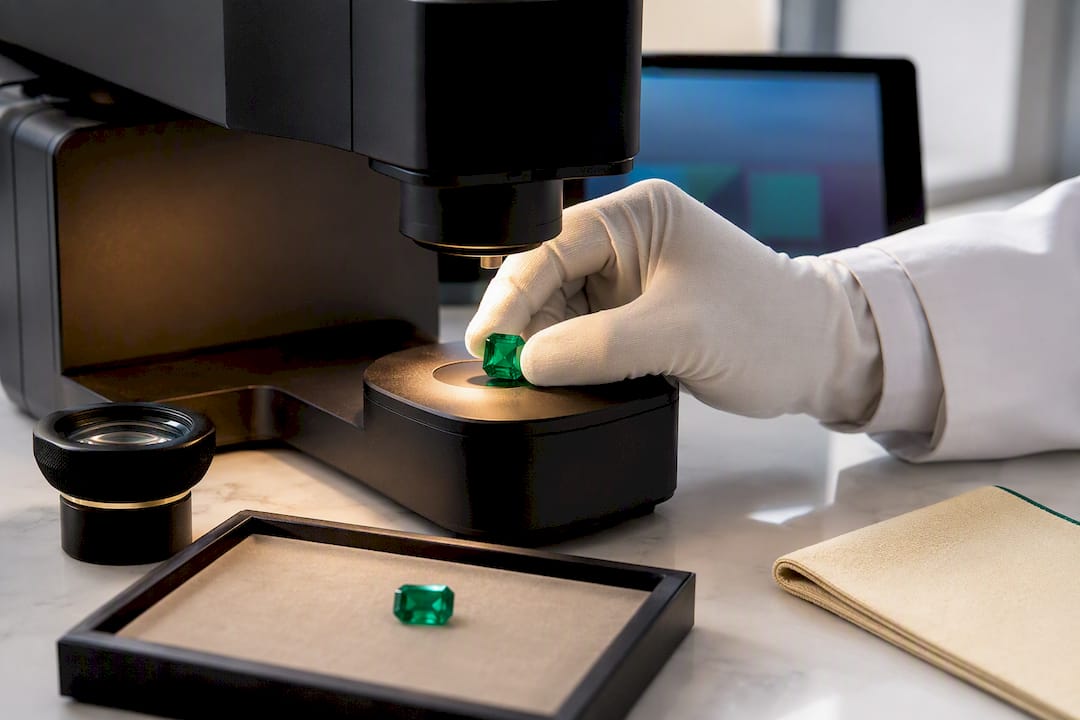
Green glass and doublets, a natural crown glued to a colored base, remain the most common low-end imitations for both origins. These usually show obvious bubbles or a flat, glassy interior under magnification, and any reputable jeweler should be able to rule them out quickly.
The bottom line for either origin: a synthetic or imitation stone isn’t inherently dishonest to buy if it’s disclosed and priced accordingly. The problem only arises when a treated, synthetic, or misrepresented stone is sold as natural and undisclosed at natural-stone prices.
An Editorial Note on Color, Clarity, and Choosing Well
Most people assume the “better” emerald is whichever one looks flawless under a jeweler’s light, but that instinct misses what makes Colombian material special in the first place. A stone’s internal character, those three-phase inclusions and oil-drop textures, is part of its identity, not a defect to be embarrassed about. I’d rather see a client choose a Colombian stone with honest inclusions than a suspiciously perfect one with no documented origin.
Color pairing matters more than people expect, too. Warm Colombian green tends to glow against yellow gold, while a cooler Zambian stone can look striking set in white gold. Reach out if you want help matching a specific hue to your skin tone and gold preference, or if you want to see lab documentation before you commit.
— Antonio
Ready to Choose Your Colombian Emerald?
If bright, classic emerald green is what you’re after, a Colombian stone typically delivers that look more reliably than any other origin, and it’s the material Antonio Guzzo Fine Jewelry builds its Signature Collection around. Pieces may pair Colombian emeralds with solid 18K gold and Italian-inspired craftsmanship, designed to be lasting and elegant.
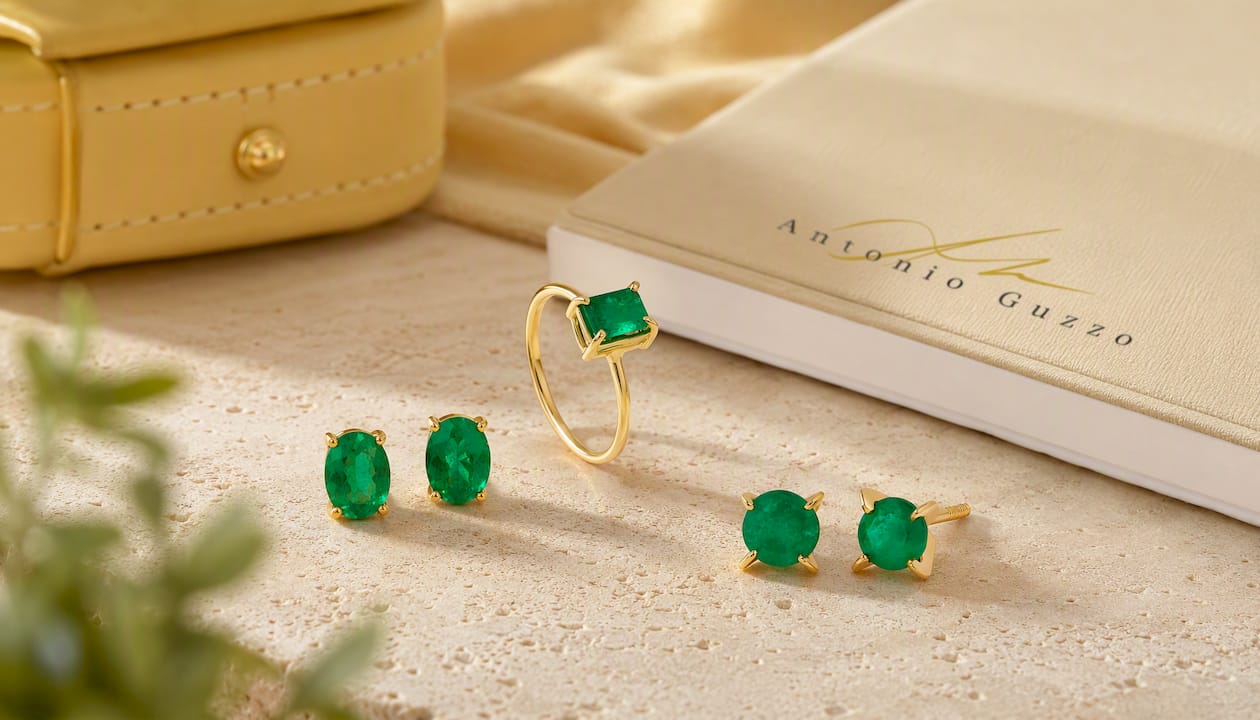
For everyday elegance, the Classic Colombian Emerald Stud Earrings in 18K Gold offer a wearable dose of that warm green. If you prefer a slightly different gold tone against the stone, the 18K Yellow Gold Colombian Emerald Stud Earrings lean into the classic pairing described above. For a statement piece or an engagement-worthy centerpiece, the Classic Colombian Emerald Ring in 18K Gold puts the stone front and center. You can also browse the full Signature Collection to see how these emeralds show up across rings, earrings, and necklaces. Every order ships free, and you can request treatment and sourcing documentation directly before you buy.
Once your piece arrives, proper care keeps that color looking its best for decades. If you want a deeper look at maintaining and protecting fine jewelry over time, this collector’s guide to value preservation covers habits that apply well beyond watches.
Browse the collection, pick the piece that matches your color preference, and request lab documentation on any stone before you check out.
Sources
- Gemmological characterisation of emeralds from Musakashi, Zambia (SSEF)
- Emeralds of Colombia (GIA PDF)
- Geographic origin determination in emeralds: photoluminescence and trace elements (Boletín Geológico y Minero)
- Emerald jewelry and gemstone information (Gems & Gem Society)
FAQ
Which Emerald Is Better, Colombian or Zambian?
Neither origin is universally “better,” since the right choice depends on what you value most. Colombian emeralds typically offer brighter, warmer green color and stronger resale prestige, while Zambian emeralds often provide cleaner clarity and better value per carat.
Which Country Has the Best Quality Emerald?
Colombia is widely regarded as the historical benchmark for emerald color quality, thanks to the vanadium and chromium content found in Muzo and Chivor material. Zambia produces higher average clarity in commercial-grade stones, so “best quality” depends on whether you’re grading for color or grading for transparency.
Are Zambian Emeralds High Quality?
Yes, Zambian emeralds, especially from the Kafubu area, are considered high quality in the trade, often prized for their clean appearance and deep bluish green tone. Musakashi material has drawn particular attention because it can closely resemble Colombian emeralds in both color and chemistry.
Are Colombian Emeralds Considered the Best?
Colombian emeralds are considered the historical and commercial standard for classic emerald color, and stones from Muzo and Chivor generally command the highest prices at comparable clarity and size. Antonio Guzzo Fine Jewelry builds its Signature Collection around natural Colombian emeralds for exactly this reason, though buyers who prioritize clarity over color history may find better value in well-documented Zambian stones.