

Insure New Jewelry Immediately, Often About 1% a Year
Yes, insure a newly purchased or sentimental piece, and do it now. The fastest path is to add it as a scheduled item on a homeowners or renters policy, or open a standalone jewelry policy, before the piece leaves the store or your hands. Expect a premium near 1% of the item’s value, and keep your receipt ready since underwriters will ask for it. For additional invaluable guidance on protecting your investment, see these tips & tricks for buying designer fashion jewelry well.
TL;DR:
- Insuring jewelry immediately after purchase is crucial to avoid coverage gaps, especially for high-value or sentimental pieces.
- Standard policies often exclude normal wear, defects, and high-risk activities, with coverage limited to theft, damage, and mysterious disappearance.
- Jewelry insurance typically costs 0.5% to 2% of the item’s value annually, with better protection available through standalone policies for expensive collections or frequent travel.
- Proper documentation, including receipts, detailed descriptions, and updated appraisals, ensures smoother claims and accurate coverage over time.
- Buyers should address coverage concerns before ownership transfer, as delays in paperwork increase the risk of uninsured losses during the initial window.
Table of Contents
- What Does an Insure Jewelry Purchase Policy Actually Cover?
- How Much Does Jewelry Insurance Cost, and When Should You Buy It?
- How Do You Insure a Jewelry Purchase Step by Step?
- Rider or Standalone Policy: Which One Fits Your Jewelry?
- What Should Owners of Handcrafted Fine Jewelry Know About Coverage?
- What Does the Research Actually Support Here?
- If You Bought From Antonio Guzzo Fine Jewelry, Here’s How We Make This Easy
- Sources
- FAQ
What Does an Insure Jewelry Purchase Policy Actually Cover?
A standard jewelry policy protects against theft, accidental damage, loss, and what insurers call “mysterious disappearance,” meaning the item is simply gone with no clear explanation. Many specialty policies extend that protection worldwide, so a ring lost abroad is treated similarly to one lost at home.
Pro Tip: Ask specifically about mysterious disappearance coverage. Many buyers assume “loss” and “mysterious disappearance” mean the same thing, but some cheaper policies exclude the latter, leaving you unprotected if a stone simply falls out of a setting and vanishes.
Coverage has real edges. Here’s what typically falls outside a standard policy:
- Normal wear and tear, like a worn prong or a clasp that finally gives out
- Manufacturing defects, which fall under the jeweler’s warranty, not insurance
- Intentional damage or losses tied to fraud
- Certain high-risk activities specified in the policy fine print
Two structural choices shape what you actually collect on a claim. Agreed value locks in a payout amount at the time you buy the policy, so there’s no argument later about what the piece was worth. Actual cash value factors in depreciation, which can leave you with less than expected. Specialty valuables insurers often offer agreed-value coverage with worldwide protection and, on qualifying items, a $0-deductible option. A recent appraisal or invoice is usually required to set that agreed value in the first place.
How Much Does Jewelry Insurance Cost, and When Should You Buy It?
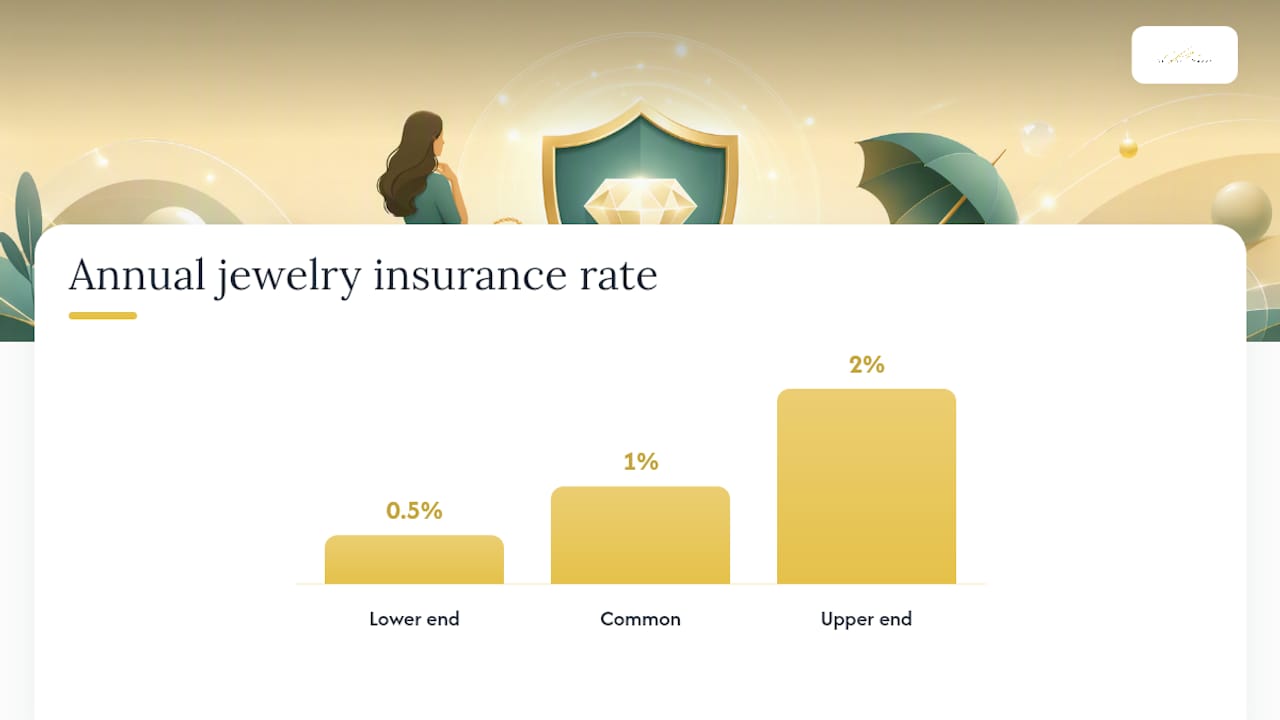
Expect to pay roughly 0.5% to 2% of your jewelry’s value annually, with 1% to 2% being the range most commonly cited by insurers. A $10,000 ring, using that math, lands somewhere between $50 and $200 a year, which is a modest hedge against losing something irreplaceable.
Several factors move that number up or down:
- Coverage type: a rider on an existing policy tends to run cheaper than a full standalone policy
- Deductible chosen: a $0-deductible plan costs more than one with a standard deductible
- Location and storage habits: a piece kept in a home safe in a low-crime area costs less to insure than one worn daily in a high-theft zip code
- Claims history and item value: prior claims and higher-value pieces both push premiums upward
The timing rule matters more than the price. Insurance experts recommend buying coverage the moment you take possession of the piece, not after the trip, not after the proposal. Some specialty policies build in a short automatic-coverage window, often 30 to 90 days, for newly acquired items, but you should confirm that window with your insurer rather than assume it applies to your policy.
How Do You Insure a Jewelry Purchase Step by Step?
Getting coverage in place takes less effort than most buyers expect. Here’s the order that avoids delays:
- Gather your documentation. Pull the invoice or receipt, a written description of the piece, clear photos, and any lab report or appraisal you have. Lower-value pieces often get by on receipts and photos alone; six-figure items typically need a certified appraisal or recent purchase invoice.
- Pick your coverage path. A rider on your existing homeowners or renters policy is the simplest option for one or two items. A standalone valuables policy suits larger collections, frequent travelers, or pieces with real sentimental weight.
- Request quotes. Underwriters commonly ask for the same package: item photos, a detailed description, and proof of purchase. Clear hallmark close-ups and a lab certificate speed up the quote and reduce disputes later.
- Activate the policy and file your proof of coverage somewhere safe, ideally both a physical folder and a cloud backup.
Pro Tip: If the piece is a gift, such as an engagement ring given as a surprise, insure it under the giver’s name first, then update the policy once ownership transfers. Waiting until after the proposal to start the paperwork is exactly the gap that causes uninsured losses.
Rider or Standalone Policy: Which One Fits Your Jewelry?
Homeowners and renters policies commonly cap jewelry theft coverage at a low sublimit, often somewhere between $1,000 and $2,500, unless you add a rider or schedule the item by name. That sublimit catches a lot of buyers off guard after a loss, when they discover the payout barely covers a fraction of the piece’s value.
A standalone jewelry policy tends to offer broader protection: worldwide coverage, agreed-value payouts, and sometimes a $0 deductible for qualifying items. A rider works fine for one or two lower-value pieces you rarely travel with. A standalone policy makes more sense once you check any of these boxes:
- The item’s value exceeds your homeowners sublimit
- The piece carries heirloom or irreplaceable sentimental value
- You travel frequently with the item
- You expect your collection to grow over time.
What Should Owners of Handcrafted Fine Jewelry Know About Coverage?
Handcrafted and heirloom pieces need a slightly different documentation habit than mass-produced jewelry. Because no two handmade pieces are perfectly identical, insurers and appraisers rely heavily on close-up photos of hallmarks, stone settings, and any engraving. Get those photos taken the week you receive the piece, while every detail is sharp and unworn.
Reappraisal every two to three years keeps your coverage aligned with current market value, particularly for natural gemstones like Colombian emeralds, which can shift in value as sourcing and demand change. Antonio Guzzo Fine Jewelry structures its product pages and order receipts so that description, materials, and provenance details are already documented at the point of sale, which removes one of the more tedious steps in the underwriting process.
The gap between owning a beautiful piece and having it properly documented is usually a matter of days, not effort. Most of the paperwork insurers ask for already exists; it just needs to be pulled together before, not after, something goes wrong.
What Does the Research Actually Support Here?
The conventional advice on jewelry insurance tends to bury the timing issue under a pile of coverage-type comparisons. That’s backwards. The single biggest risk factor isn’t picking the wrong policy type. It’s the gap between purchase and coverage, the window where a piece sits uninsured because nobody got around to the paperwork.
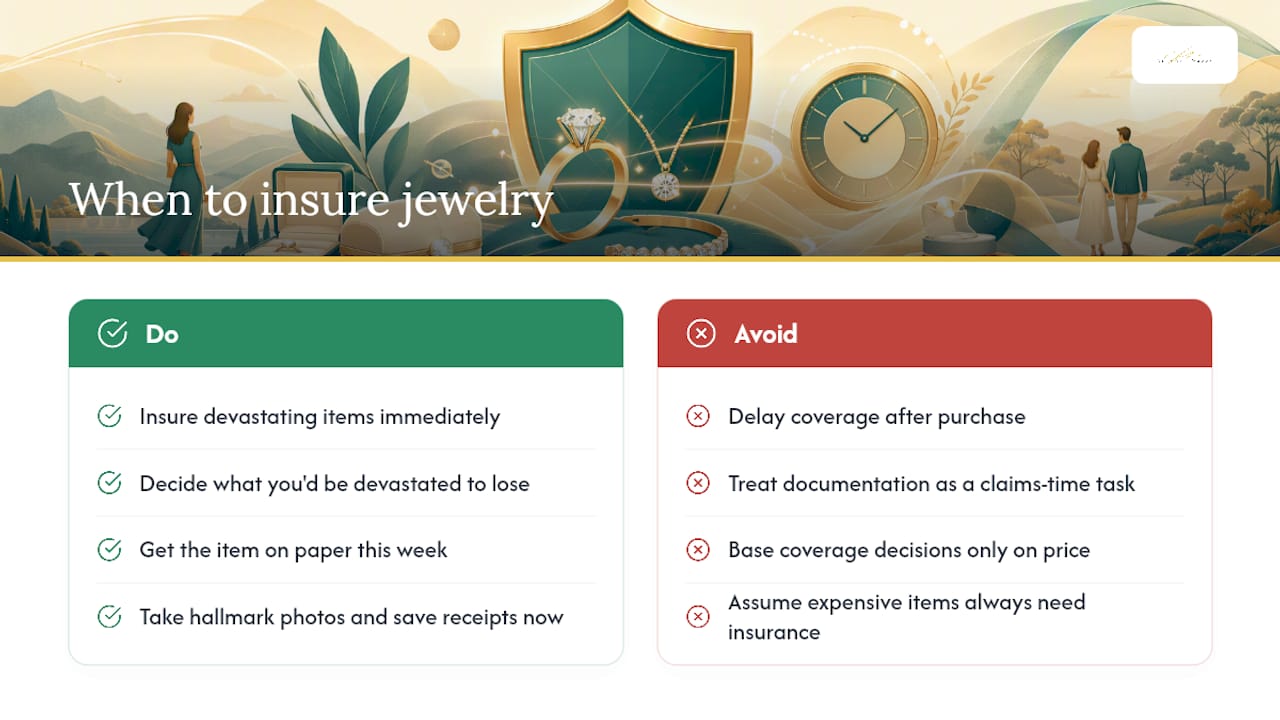
The research is consistent on one point: insure what would be financially or emotionally devastating to replace, not just what’s expensive. A $2,000 ring that was your grandmother’s carries a different insurance calculus than a $2,000 piece you’d shrug off losing. Cost comparisons and deductible math matter, but they’re a second step. The first step is deciding, honestly, what you’d be devastated to lose, then getting that item on paper with an insurer this week.
Where most buyers go wrong is treating documentation as a claims-time task. By then it’s too late to take clean hallmark photos or track down a receipt buried in an inbox from months ago.
— Antonio
If You Bought From Antonio Guzzo Fine Jewelry, Here’s How We Make This Easy
Antonio Guzzo Fine Jewelry keeps your documentation trail simple from the moment you check out. Every order comes with a receipt, and each piece’s product page holds the item description and photography you’ll need for a quote or a claim.
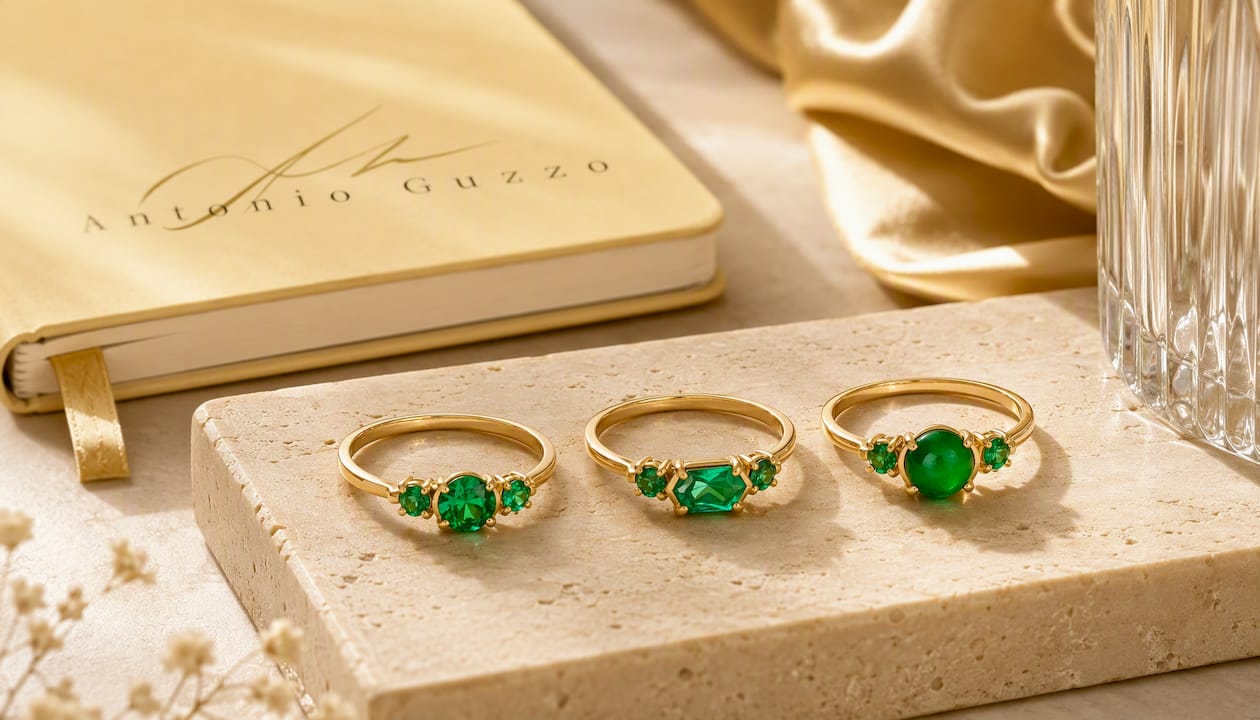
If you purchased the Exquisite 18K Trilogy Emerald Ring, the 18K Yellow Gold Natural Emerald Trilogy Ring, or the Emerald Trilogy Ring in 18K Gold, your product page still holds the stone details, gold weight, and imagery an underwriter will ask for. Save your receipt the day it arrives, and if your insurer requests an appraisal beyond what the product listing provides, ask us for a recommendation. Visit your product page today to pull your purchase record before you request an insurance quote.
Sources
For readers who want to check policy language directly, these are worth a closer look before you sign anything:
- How to Insure Jewelry | Forbes Advisor
- When to Get Jewelry Insurance? | BriteCo blog
- Insurance for Jewelry, Watches, Rings & More | Chubb
Every policy differs by insurer and state, so read your specific contract’s fine print rather than relying on general guidance alone.
FAQ
How much does it cost to insure a $10,000 ring?
Expect roughly $50 to $200 per year, based on the commonly cited 1% to 2% of value range that most jewelry insurers use as a baseline.
Is insuring jewelry worth it?
For most valuable or sentimental pieces, yes. The annual premium is small compared to the cost of replacing something that’s financially or emotionally difficult to lose, especially daily-wear or heirloom items.
Should you insure a $3,000 ring?
If losing it would sting financially or emotionally, insure it. A rider on your homeowners or renters policy often covers a piece at this value, though check your sublimit first since standard theft limits can sit as low as $1,000 to $2,500.
Which company is best for insuring jewelry?
There’s no single best insurer for every situation. The right fit depends on whether you need a simple homeowners rider or a standalone policy with agreed value and worldwide coverage, so compare a few quotes against your specific piece and travel habits.
What documents do I need to insure jewelry?
Most insurers want an invoice or receipt, clear photos, a written item description, and an appraisal for higher-value pieces. Antonio Guzzo Fine Jewelry’s product pages and order receipts already cover most of that for pieces purchased there.