

Emerald Symbolism for Heirlooms: How GIA and Museum Lore Shape Design
Emeralds symbolize renewal, enduring love, wisdom, and prosperity, an association GIA traces through thousands of years of history and lore. The gem also carries modern weight as the official May birthstone and the traditional gift for 20th and 35th wedding anniversaries. What follows traces where those meanings came from, how different cultures shaped them, and what they mean for anyone choosing an emerald today.
TL;DR:
- Emeralds have been historically associated with authority, sacred devotion, and royal wealth, with sources dating back to Egypt and Colombia’s colonial period.
- Different cultures linked emeralds to fertility, love, truth, and divine favor, reinforcing the gemstone’s deep-rooted symbolism of life force and renewal.
- Modern beliefs reframe emerald lore as emotional rather than physical, emphasizing its use for heart chakra healing and personal growth rather than literal powers.
- When selecting an emerald, prioritize rich color saturation and protect it with a secure setting due to natural inclusions that can increase chipping risk.
- Emeralds are best suited for milestone or heirloom jewelry, symbolizing longevity, loyalty, and transformation, especially in anniversary and birthstone designs.
Table of Contents
- The History Behind Emerald Symbolism
- How Different Cultures Have Interpreted Emerald Meaning
- Emerald’s Spiritual and Healing Lore, Then and Now
- Emerald as the May Birthstone: Astrology and Anniversary Meaning
- Emerald in Art, Museums, and Popular Imagination
- Choosing and Caring for Emeralds That Reflect Their Meaning
- How Antonio Guzzo Fine Jewelry Brings Emerald Symbolism Into Design
- What Emerald Green Does to the Mind
- Emerald vs. Other Green Gemstones: What Sets the Symbolism Apart
- Why Symbolism Shapes Every Design Decision We Make
- Find Your Emerald in the Signature Collection
- Sources
- FAQ
The History Behind Emerald Symbolism
The word “emerald” descends from the Ancient Greek smaragdus, meaning simply “green gem.” That single word carried enormous weight in the ancient world, where green was rare in mineral form and prized accordingly. GIA’s history of the stone notes that emeralds have been mined and traded for thousands of years, with some of the earliest known sources located in Egypt, long before Colombia became the modern benchmark for quality.
Egyptian miners worked emerald deposits near the Red Sea in ancient times, dating back several millennia, and the stone turns up in burial sites tied to fertility and rebirth beliefs. Centuries later, Colombia’s Muzo and Chivor mines became the world’s dominant source, producing the deep, slightly bluish green that collectors still consider the standard today.
Royal history did as much to shape emerald symbolism as geology did:
- Cleopatra was famously obsessed with emeralds, reportedly claiming entire Egyptian mines for her personal collection and gifting the stones as symbols of her power.
- Mughal emperors in India had emeralds carved with sacred inscriptions, turning gemstones into religious talismans worn by rulers.
- The Crown of the Andes, a colonial-era Colombian religious artifact now studied in museum collections, is set with over 450 emeralds and stands as one of the clearest links between the stone, sacred devotion, and imperial wealth.
Each of these examples did the same thing: they attached emerald to authority, and authority reinforced the stone’s symbolic status for the next dynasty that wore it.
How Different Cultures Have Interpreted Emerald Meaning
Emerald symbolism never developed in one place. It grew in parallel across civilizations that had no contact with each other, which is part of why the same themes, rebirth, truth, and love, keep resurfacing.
- Egyptian tradition tied the stone to fertility and eternal life, which is why emeralds appear in burial contexts as protective objects meant to accompany the dead into the next existence.
- Greco-Roman belief linked emerald to Venus, the goddess of love, and to eloquence in speech. The Roman naturalist Pliny the Elder wrote that gazing at emerald relieved tired eyes, a claim that shaped centuries of belief about the stone’s restorative color.
- Hebrew and medieval European sources associated emerald with truth-telling and clear judgment, sometimes listing it among the biblical stones tied to wisdom and divine favor.
- Mughal India treated emerald as a devotional stone, engraving verses onto polished surfaces so the gem itself became a portable prayer.
- Indigenous South American cultures, particularly those near Colombia’s emerald belt, regarded the stone as sacred long before European colonization, using it in religious offerings that later fed directly into Spanish colonial artifacts like the Crown of the Andes.
The throughline across all of these traditions is remarkable: whether the culture emphasized love, truth, or fertility, green consistently represented life force. That consistency is a large part of why emerald reads as “the heart of spring” across nearly every tradition that has handled the stone.
Emerald’s Spiritual and Healing Lore, Then and Now
Historical claims about emerald read like a catalog of hopeful superstition. Ancient and medieval writers credited the stone with prophetic powers, believing it could reveal future events to its wearer or even change color to warn of danger. Some traditions used emerald as a literal fidelity test, claiming the stone would cloud or crack if a lover’s promise had been broken. GIA’s documentation of emerald lore also records widespread belief that the gem cured eye strain, improved memory, and sharpened eloquence.
None of that is documented physical behavior. A gemstone does not sense betrayal, and no mineral structure changes based on a person’s honesty. These claims say more about how much cultures wanted meaning attached to something beautiful and rare than they say about mineralogy.
Modern spiritual practice has reinterpreted rather than abandoned this lore. Crystal healing traditions today associate emerald with the heart chakra, using it during meditation for emotional balance, compassion, and openness to love. Others keep emerald nearby as a personal symbol of renewal during a life transition, leaning on the same “spring stone” imagery that Egyptian and Greek cultures established millennia ago.
Pro Tip: If you’re drawn to emerald for its emotional symbolism, treat that meaning as personal and reflective rather than medical. Wear it because the color and story resonate with you, not because it claims to cure anything.
Emerald as the May Birthstone: Astrology and Anniversary Meaning
Emerald holds official status as the May birthstone, a designation that fits the month almost too neatly. May sits at the height of spring in the Northern Hemisphere, and emerald’s saturated green mirrors new leaves and fresh growth in a way few other gemstones can match.
- Anniversary tradition assigns emerald to both the 20th and 35th wedding anniversaries, marking milestones associated with deepening, mature commitment.
- Astrological association connects emerald primarily to Taurus, a sign linked to loyalty, patience, and steady growth, and secondarily to Gemini, tied to communication and mental clarity.
- Cultural sources like Farmer’s Almanac record these zodiac links alongside broader associations with fertility, wisdom, and enduring love.
Taken together, these conventions explain why emerald shows up so often in engagement and anniversary jewelry: it is simultaneously a birthstone, a milestone marker, and a zodiac symbol pointing toward stability rather than fleeting romance.
Emerald in Art, Museums, and Popular Imagination
Museum collections give emerald symbolism something abstract lore can’t: physical proof. Carved Mughal emeralds and devotional pieces like the Crown of the Andes show the stone functioning as both status symbol and sacred object, sometimes in the same piece.
- Literary and pop-culture references kept the symbolism alive well past the age of empires. L. Frank Baum’s Emerald City in The Wonderful Wizard of Oz used the color as shorthand for an idealized, almost magical destination, borrowing directly from centuries of green-as-wonder imagery.
- National symbolism reinforced the same association elsewhere. Ireland’s nickname, the Emerald Isle, ties the color to lushness and renewal on a national scale, echoing the same spring associations that shaped the gemstone’s meaning.
- Royal portraiture and jewelry across European and Mughal courts repeatedly used emerald to signal wealth paired with refinement, rather than raw power alone, which is closer to how diamonds got used.
The pattern holds across mediums: whenever a culture needed a quick visual signal for growth, wonder, or abundance, green stone imagery did the work.
Choosing and Caring for Emeralds That Reflect Their Meaning
Buying an emerald with symbolism in mind changes what you should look for. Renewal and enduring love are the themes people reach for most often, which makes emerald a natural choice for engagements, anniversaries, and heirloom pieces meant to carry a story forward.
- Prioritize color saturation over flawless clarity. A rich, even green matters more to emerald’s visual impact than the near-invisible inclusions gemologists expect to see.
- Learn the term “jardin.” Gemologists use this word to describe the garden-like internal inclusions found in nearly every natural emerald. Far from a flaw, jardin is often a sign the stone wasn’t lab-grown.
- Choose protective settings. Emeralds rank 7.5 to 8 on the Mohs hardness scale, tough on paper, but their natural inclusions make them more prone to chipping under impact than harder stones like sapphire. Bezel or halo settings shield the edges better than exposed prong settings do.
- Skip ultrasonic cleaners entirely. Harsh chemicals and vibration can widen existing inclusions. A soft cloth and mild soap and water are the safer standard.
Pro Tip: Ask about the jardin pattern before buying. A visible, natural garden-like inclusion pattern is often a better authenticity signal than a suspiciously clean, inclusion-free stone at a bargain price.
For a deeper walkthrough on keeping stones and metal in good condition long term, see this guide on cleaning gold and silver jewelry with real stones, and this partner resource on storing sterling silver jewelry properly between wears.
How Antonio Guzzo Fine Jewelry Brings Emerald Symbolism Into Design
Every piece in this jewelry collection starts from the same question: what story is this stone meant to carry? Each design is built around natural Colombian emeralds sourced through ethical practices, finished with artisan techniques.
- The 18K Natural Emerald Floral Earrings lean into the flower and growth imagery tied to renewal.
- The Dragonfly Emerald Necklace in 14K gold uses a transformation motif that echoes the same spring symbolism emerald has carried since antiquity.
- The Emerald Trilogy Ring in 18K gold sets three stones together, a natural fit for anniversary or heirloom gifting where past, present, and future carry equal weight.
Each design choice traces back to a symbolic thread the stone has carried for centuries, not an arbitrary aesthetic decision.
What Emerald Green Does to the Mind
Green sits at the exact center of the visible spectrum, and human eyes process it with less strain than almost any other hue. That’s not folklore; it’s a documented reason green has long been associated with calm and restored focus, the same physiological basis behind Pliny’s ancient claim that gazing at emerald soothed tired eyes.
Psychologically, green consistently reads as balance rather than excitement. Where red signals urgency and blue signals calm detachment, green sits in between: alert but settled. That’s likely why emerald became shorthand for renewal rather than passion. Passion belongs to red stones like ruby. Emerald’s green suggests something steadier: growth that has already taken root rather than a spark that might fade.
Designers and colorists still lean on this today. Deep emerald green shows up in branding meant to suggest trust and stability, in interior design meant to feel grounding, and in fashion collections built around the idea of quiet confidence rather than flash. Wearing emerald jewelry taps into that same psychological register. It doesn’t shout for attention the way a large diamond or a bright ruby might. It reads as intentional, settled, and personal, which is exactly why it works so well for pieces meant to mark a lasting relationship rather than a fleeting moment.
Emerald vs. Other Green Gemstones: What Sets the Symbolism Apart
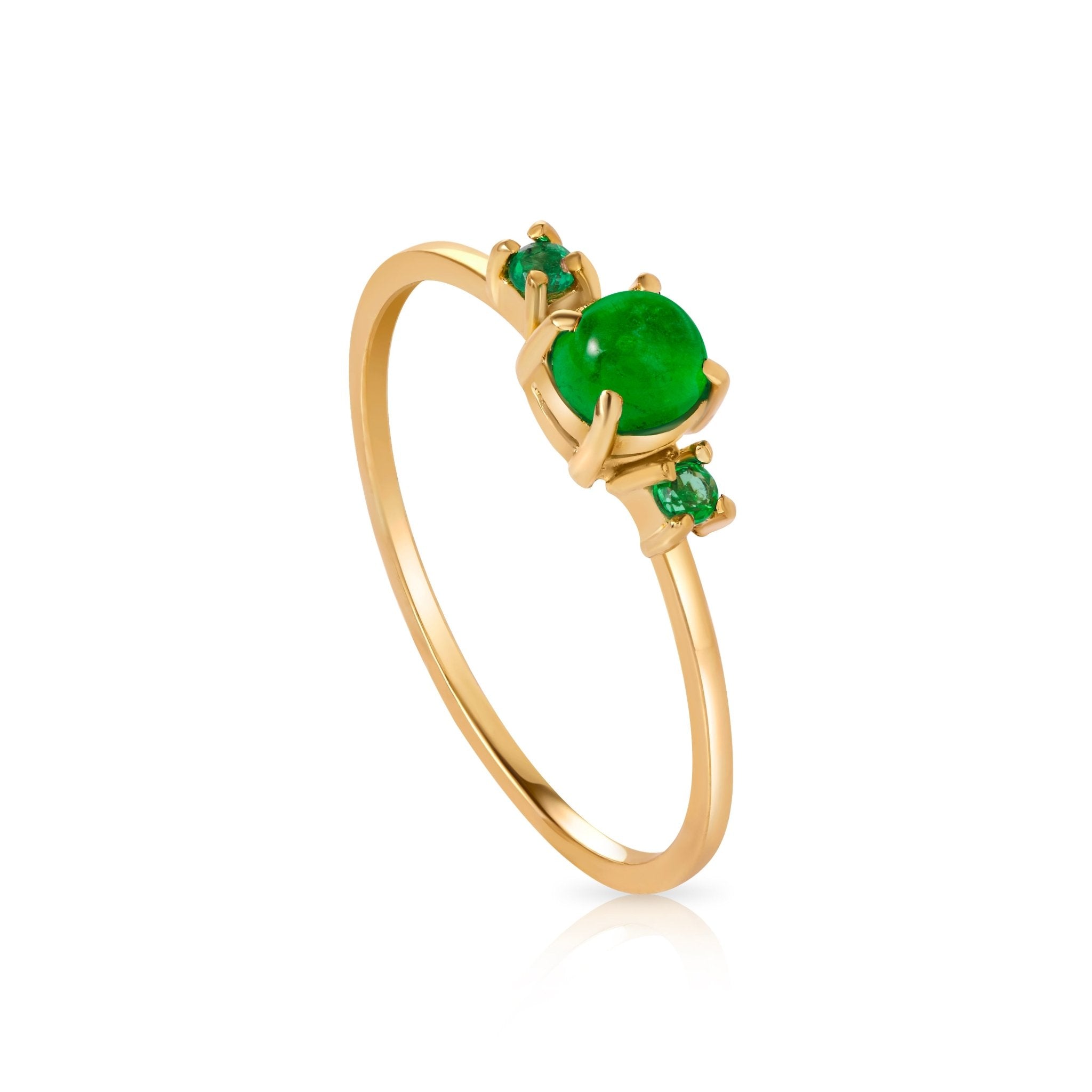
Green gemstones share a color family, but they don’t share a symbolic history. Peridot, another vivid green stone, carries its own birthstone status for August and its own folklore, often tied to protection rather than renewal. Its lighter, yellow-green tone reads as brighter and more casual, lacking emerald’s centuries-deep association with royalty and sacred use.
Green tourmaline, increasingly popular in modern jewelry, has almost no ancient symbolic baggage at all. It’s a relatively recent gem on the world stage, prized for clarity and affordability rather than any inherited mythology. That absence of history is itself telling: emerald’s symbolism isn’t just about the color green, it’s about thousands of years of documented royal ownership, religious use, and recorded belief that other green stones simply haven’t accumulated.
Jade occupies a different cultural lane entirely, carrying enormous symbolic weight in Chinese tradition specifically, tied to virtue, protection, and social status in a way that runs parallel to, rather than overlapping with, emerald’s Mediterranean and South American history.
What separates emerald from all of them is the density of unbroken historical reinforcement, from Egyptian burial sites through Mughal court jewels to Colombian colonial artifacts. Other green stones have fragments of that story. Emerald has the whole arc.
Why Symbolism Shapes Every Design Decision We Make
Meaning is the reason a customer chooses one stone over another, so we treat it as a design input, not a marketing afterthought. When we set a Colombian emerald into an anniversary ring or a floral earring, we’re building toward the renewal and loyalty the stone has represented for thousands of years, not just its color. If that history resonates with your own story, our Signature Collection is worth a look.
— Antonio
Find Your Emerald in the Signature Collection
Your Story in Gold: The Signature Collection was built around exactly this idea, that a stone tied to renewal, love, and centuries of royal history deserves a setting that respects its story. Every piece uses ethically sourced natural Colombian emeralds and artisan craftsmanship.
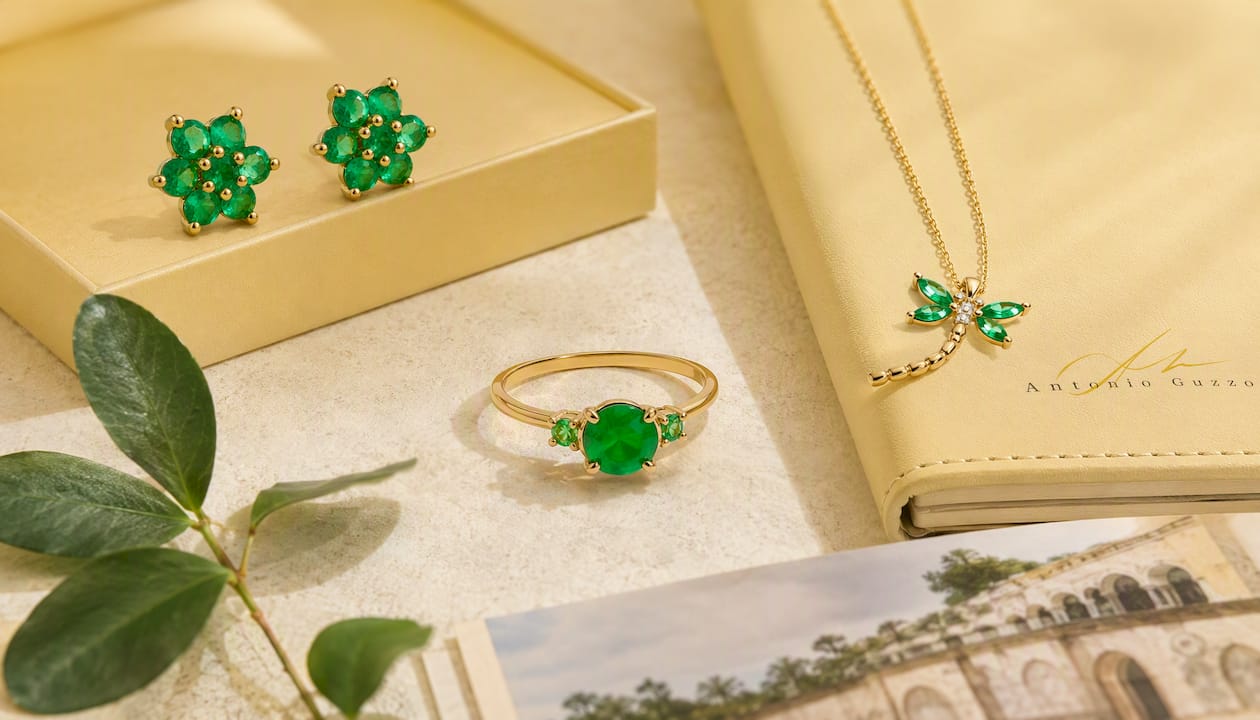
Three pieces make that symbolism easy to wear right now. The 18K Natural Emerald Floral Earrings carry the growth and renewal theme in a floral silhouette suited to everyday wear. The Dragonfly Emerald Necklace in 14K gold speaks to transformation, a fitting gift for a milestone or new chapter. The Emerald Trilogy Ring in 18K gold fits the 20th or 35th anniversary tradition directly, three stones set together as a compact symbol of past, present, and future.
If you’re shopping for an engagement or heirloom piece instead, browse the Exquisite Ring Collection or explore gold necklaces and pendants for a different way to carry the same meaning. Start with the Signature Collection and pick the piece that matches the story you want to tell.
Sources
- GIA — Emerald history & lore
- International Colored Gemstone Association — Emerald
- Farmer’s Almanac — May birthstone
- The Metropolitan Museum of Art — relevant emerald collection entries
FAQ
What is the spiritual meaning of the emerald?
Emerald’s spiritual meaning centers on renewal, emotional balance, and love, themes that trace back to ancient beliefs about the stone’s connection to spring and rebirth. Many modern spiritual practices associate it with the heart chakra, using it during meditation to encourage compassion and openness.
What does it mean to wear an emerald?
Wearing an emerald traditionally signals a connection to renewal, loyalty, and steady growth rather than fleeting passion, which is part of why it’s favored for anniversaries and engagements. It’s also worn simply as the May birthstone, marking a personal or family connection to that month.
Why can’t you wear emeralds every day?
Emeralds measure 7.5 to 8 on the Mohs hardness scale, but their natural jardin inclusions make them more prone to chipping under impact than harder gems like sapphire. Daily wear is fine with a protective setting like a bezel, but the stone should be kept away from harsh chemicals and high-impact activity.
What does the emerald symbolize?
The emerald symbolizes renewal, enduring love, wisdom, and prosperity, meanings built up over thousands of years across Egyptian, Greco-Roman, Mughal, and South American traditions. It’s also tied to Taurus in astrology and serves as the traditional gift for 20th and 35th wedding anniversaries.