

Buyers: Read Emerald Inclusions to Confirm Origin and Durability
Emerald inclusions are the internal solids, liquids, and gas bubbles, often called a jardin, that occur naturally inside nearly every emerald. They aren’t defects to apologize for. Gemologists rely on them to separate natural stones from synthetics, catch undisclosed treatments, and judge how a stone will hold up in daily wear. Most emeralds show eye-visible inclusions, and that’s expected, not alarming.
TL;DR:
- Most emeralds have visible inclusions, which are expected and used to verify natural origin, with three-phase “pea-pod” inclusions being common in Colombian stones.
- Inclusions that block light or compromise structural integrity affect value and durability more than their mere presence, making proper setting and care essential.
- An experienced jeweler can identify synthetic emeralds by detecting characteristic bubble shapes, growth patterns, and flux remnants, but lab reports ensure certainty.
- Treatments like fracture fills are standard and disclose to buyers, with fillers varying in stability; always verify what filler was used and its permanence.
- The appearance of internal inclusions and the garden pattern can provide clues about geographic origin, but definitive sourcing requires integrated lab analysis.
Table of Contents
- What Are the Types of Emerald Inclusions?
- How Inclusions Affect Emerald Value and Durability
- Can a Jeweler Tell If an Emerald Is Natural or Lab-Grown?
- How to Identify Emerald Clarity Enhancements
- How Antonio Guzzo Fine Jewelry Approaches Emeralds With Visible Inclusions
- Where Do Emerald Inclusions Actually Come From?
- Does Geographic Origin Change What Inclusions Look Like?
- How Do Emerald Inclusions Compare to Inclusions in Other Gemstones?
- How Do Inclusions Affect Cutting and Shaping an Emerald?
- What Does a Classic Jardin Actually Look Like?
- Why I Think Jardin Deserves More Respect Than It Gets
- Explore Settings Built Around Emerald Inclusions
- Sources
- FAQ
What Are the Types of Emerald Inclusions?
Gemologists sort emerald inclusions by physical state: single-phase, two-phase, and three-phase. The distinction sounds academic, but it’s the fastest way to understand what you’re looking at under a loupe.
Single-phase inclusions are solid mineral crystals trapped during the emerald’s growth. Mica flakes, pyrite specks, and actinolite needles are common examples, and they often look like tiny dark flecks or metallic glints suspended in the stone.
Two-phase inclusions contain a liquid and a gas bubble sharing the same cavity, usually appearing as small, elongated pockets with a visible bubble that shifts slightly when the stone is tilted.
Three-phase inclusions add a solid crystal to that liquid-and-gas mix. These are sometimes nicknamed “pea-pod” inclusions for their shape, and they’re a well-known diagnostic feature described in detailed visual identification guides. Three-phase inclusions show up frequently in Colombian material, though GIA research confirms they’re not exclusive to Colombia. Origin claims need more than one inclusion type to hold up.
Beyond these three categories, watch for:
- Feathers: fracture planes that catch light and can look like tiny cracks or wisps.
- Veils: curtain-like networks of small liquid inclusions, often the ghost of a healed fracture.
- Growth tubes: long, hollow channels formed as the crystal grew.
- Parallel needles: fine, aligned mineral fibers.
- Color zoning: bands of uneven green saturation.
- Trapiche pattern: a rare six-spoke, wheel-like structure caused by uneven growth.
Pro Tip: Start with a 10x loupe in good light and rotate the stone slowly. Irregular, organic-looking inclusions with varied shapes point toward a natural origin; suspiciously uniform patterns deserve a second look under a microscope.
How Inclusions Affect Emerald Value and Durability
Buyers often assume clarity works the same way across every gemstone. It doesn’t. Emerald is graded on a different curve, and understanding why changes how you shop.
The trade tolerates inclusions in emerald far more than it does in diamond, because GIA’s quality standards treat jardin as expected, not disqualifying. Value drops only when inclusions block light transmission or threaten the stone’s structural integrity, not simply because they exist. A stone with a moderate garden that still reads bright and transparent can outvalue a paler stone that looks “cleaner” but lacks depth of color. Truly eye-clean emeralds are rare enough that their scarcity, not their flawlessness alone, drives the premium.
Durability is the flip side of the same coin. Emerald measures a hardness between moderate to relatively high on the Mohs scale, which sounds tough, but the International Colored Gemstone Association notes that inclusions and internal fractures reduce toughness regardless of that hardness number. A stone can resist scratching and still chip if struck at the wrong angle along a feather.
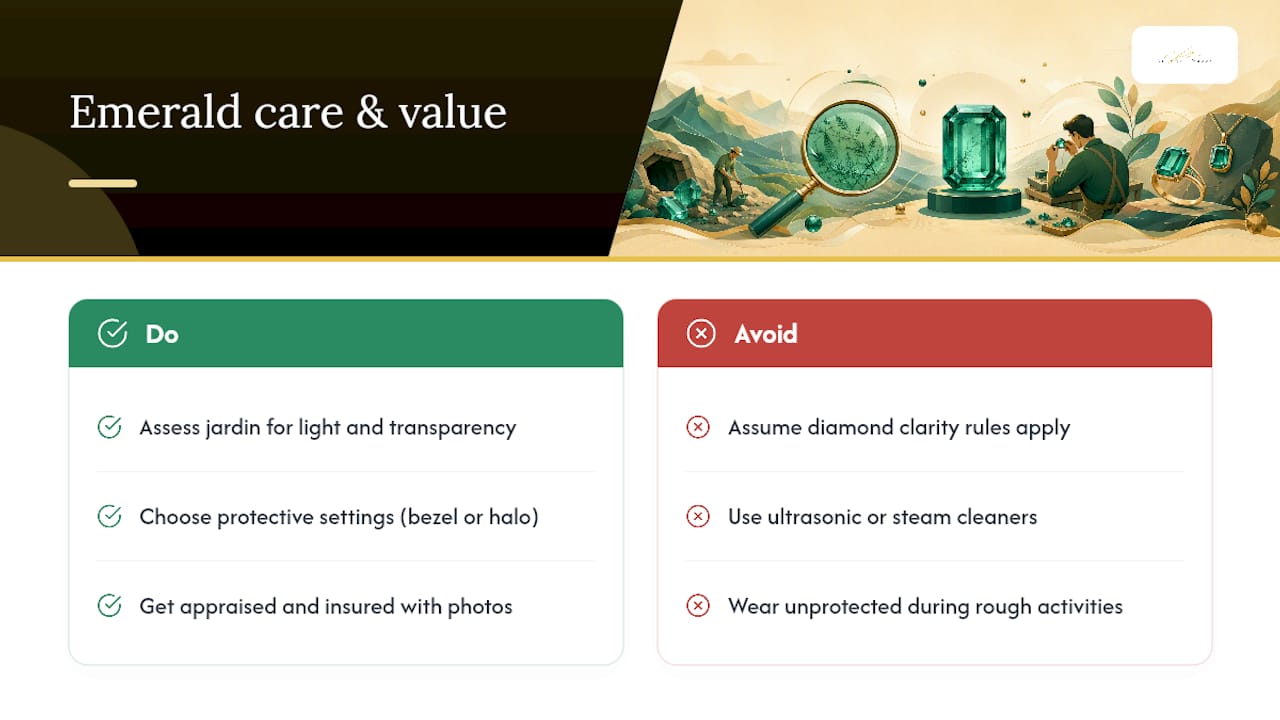
That reality should shape how you wear and maintain the piece. Skip ultrasonic and steam cleaners, which can widen existing fractures or loosen fills. Choose protective settings like bezels or halos that shield the edges. And get any significant emerald appraised and insured with photos on file, since replacement value depends heavily on documented clarity and origin.
Can a Jeweler Tell If an Emerald Is Natural or Lab-Grown?
Trained eyes and a microscope can catch most red flags, though not every case resolves without lab equipment. Here’s the general sequence a jeweler follows:
- Check bubble shape. Natural emeralds show irregular, randomly scattered bubbles. Synthetics frequently show flattened, geometric gas bubbles from controlled lab growth conditions.
- Look for growth zoning. Natural stones display uneven, organic zoning. Lab-grown material often shows suspiciously consistent, repeating zoning patterns.
- Watch for flux remnants. Flux-grown synthetics can trap phenakite crystals or wispy, curtain-like “Venetian blind” structures rarely seen in natural stones.
- Note the inclusion variety. GIA’s photomicrograph research shows natural emeralds carry a diverse suite of mineral inclusions, while synthetics tend toward a narrower, more repetitive inclusion set.
- Account for treatments. Fracture fills can flatten natural bubble shapes or introduce a flash effect, muddying the picture further.
When the visual evidence is ambiguous, that’s the moment to request a report from a recognized gemological lab like GIA, AGS, or AGL. Spectroscopy and trace-element analysis settle questions a loupe simply can’t.
How to Identify Emerald Clarity Enhancements
Most emeralds on the market have been fracture-filled to improve transparency, and that’s standard industry practice, not a hidden defect, as long as it’s disclosed. The fillers are usually natural oils like cedarwood oil, synthetic resins, polymers, or occasionally flux.
Each leaves telltale signs under magnification:
- Flash effect: a flare of orange, blue, or purple light as the stone is tilted, caused by the filler’s different refractive index.
- Flattened gas bubbles: trapped inside the filled fracture rather than the stone itself.
- Roiled or streaky zones: areas where the filler hasn’t settled evenly.
Permanence varies by filler type. Natural oils can dry out or seep with heat and cleaning. Resins and polymers tend to be more stable but aren’t necessarily permanent either, based on how GIA characterizes treated emerald behavior. Ask the seller what filler was used, whether it’s disclosed on any accompanying paperwork, and whether the lab report specifies the enhancement level, from minor to significant.
How Antonio Guzzo Fine Jewelry Approaches Emeralds With Visible Inclusions
Antonio Guzzo Fine Jewelry sources natural Colombian emeralds through ethical channels, and that sourcing decision shapes every design choice that follows. A stone with a visible jardin isn’t treated as a compromise. It’s treated as a design constraint the setting has to answer.
The Signature Collection reflects that thinking directly:
- Protective bezel and halo settings reduce stress on stones with extensive internal fracturing.
- Artisan metalwork is planned around each stone’s individual inclusion map, not a generic template.
- Every piece is built to be worn and passed down, not just photographed once and shelved.
Selecting a setting for an included emerald is closer to structural engineering than pure decoration.
Where Do Emerald Inclusions Actually Come From?
Emerald forms deep underground under intense heat and pressure, and that violent birth is exactly why inclusions happen. Beryllium, the element that makes emerald green when combined with chromium or vanadium, rarely occurs alongside the other minerals emerald needs to crystallize. Emerald deposits typically form where beryllium-rich fluids meet host rock through hydrothermal activity, forcing minerals together that wouldn’t otherwise mix.
That chaotic formation process traps whatever happens to be present at the moment of crystallization. Tiny pockets of the original mineral-rich fluid get sealed inside as two-phase or three-phase inclusions. Solid mineral fragments like mica, pyrite, or actinolite get caught mid-growth as single-phase inclusions. Growth interruptions, temperature swings, and pressure changes create feathers, veils, and zoning as the crystal struggles to grow evenly.
None of this is random noise. Mineral inclusions act as a kind of geological diary, and certain species point toward specific host rock chemistry that can hint at a mining district when paired with proper lab analysis. That’s part of why gemologists study inclusions so carefully. They’re not just clarity flaws. They’re a record of exactly where and how the crystal grew.
Does Geographic Origin Change What Inclusions Look Like?
Origin matters more to inclusion character than most buyers realize. Colombian emeralds, particularly from the Muzo and Chivor mines, are famous for three-phase pea-pod inclusions and a jardin that often reads as soft, mossy, and deeply saturated. Zambian material tends to show a bluer green with different mineral inclusions tied to its distinct host rock chemistry. Brazilian and Zimbabwean stones bring their own inclusion fingerprints, shaped by whatever minerals happened to be nearby during formation.
That said, three-phase inclusions aren’t a Colombian exclusive, a point GIA’s own research makes clear. They’ve turned up in material from other deposits too, which means inclusion type alone can’t settle an origin claim. A gemologist making a confident origin call combines microscopic inclusion study with spectroscopy and trace-element analysis, since modern origin determination depends on that fuller picture rather than a single visual cue.
For buyers, the practical takeaway is this: geographic origin can influence price and desirability, especially for Colombian stones with strong provenance, but origin claims without lab backing deserve a healthy amount of skepticism. Inclusion appearance is a clue, not a verdict.
How Do Emerald Inclusions Compare to Inclusions in Other Gemstones?
Emerald sits in a different clarity category than most gems you’ll shop for, and knowing that changes what “good clarity” even means. The GIA’s clarity grading system for colored stones places emerald in Type III, the category expected to show inclusions visible to the naked eye in the vast majority of specimens. Diamonds and most sapphires and rubies fall into Type I or Type II, where eye-visible inclusions are rarer and penalized more heavily.
That difference shows up directly in price behavior. A diamond with visible inclusions gets marked down hard. An emerald with a moderate jardin can still command a strong price if the color and transparency hold up, because the market has priced in the expectation of visible inclusions from the start.
The inclusion types themselves also differ by mineral. Ruby and sapphire, both corundum, tend to show needle-like rutile inclusions and color zoning rather than the three-phase pockets specific to emerald’s beryl structure. Diamond inclusions are typically other minerals like garnet or graphite, or internal fractures, but diamond’s crystal structure doesn’t trap the same liquid-and-gas combinations beryl does. Quartz and tourmaline can show their own liquid inclusions, but rarely with emerald’s characteristic garden density.
Comparing across gem types is a useful reminder that “clarity” isn’t one universal standard. It’s a scale calibrated to what’s normal for that particular mineral.
How Do Inclusions Affect Cutting and Shaping an Emerald?
Cutting an included emerald is closer to a negotiation than a straightforward technical process. Every fracture and jardin pocket is a potential breaking point, and a skilled cutter has to plan the entire shape around avoiding them rather than maximizing carat weight.
Surface-reaching fractures are the biggest hazard. If a feather runs close to the surface, a standard brilliant cut can put stress exactly where the stone is weakest, risking a chip during cutting, setting, or years later during normal wear. Cutters often orient the table and facets to route around known inclusion clusters, even when that means sacrificing weight that a flawless rough could have kept.
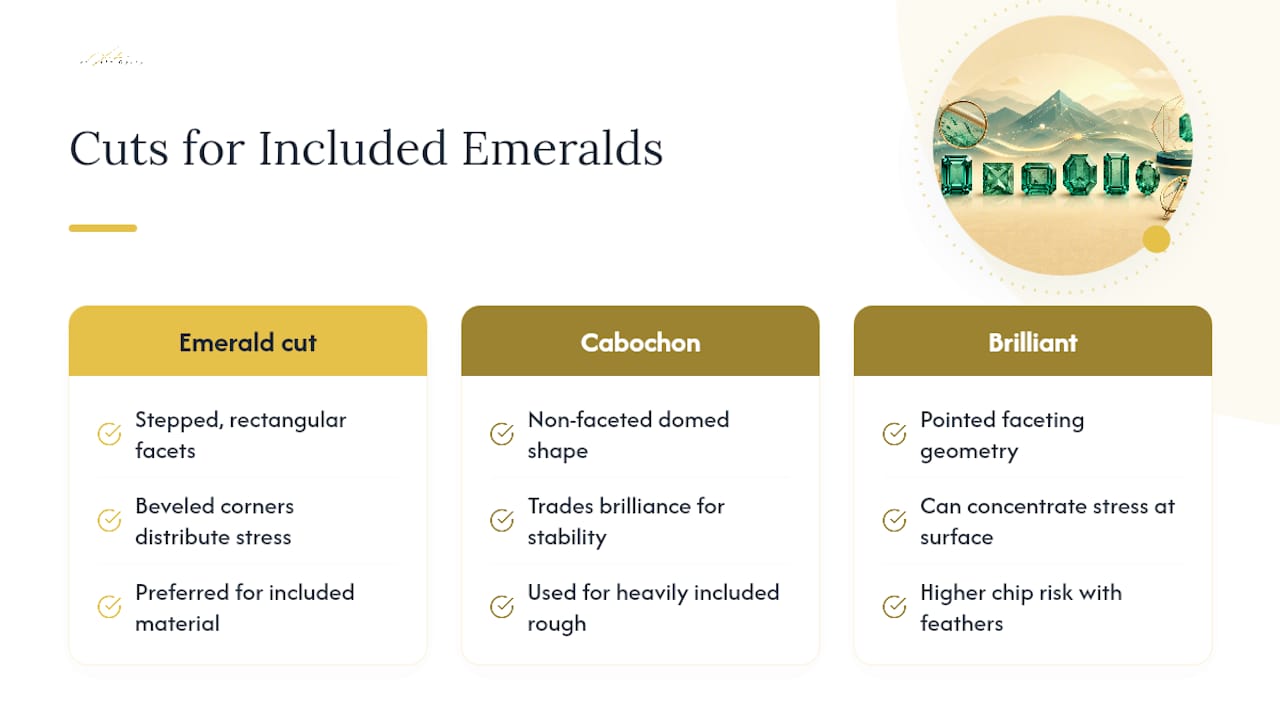
That’s one reason the emerald cut itself exists. Its stepped, rectangular facets with beveled corners distribute stress more evenly across the stone than pointed brilliant-cut facets do, which is exactly why it became the go-to shape for included material rather than a design trend. Cabochon cuts serve a similar purpose for heavily included rough that wouldn’t hold up faceted at all, trading brilliance for stability.
Setting choices pick up where cutting leaves off. As GIA notes on setting strategy, bezel and protective halo settings reduce risk for emeralds with extensive jardins by shielding vulnerable edges from impact, which is part of why so many fine emerald rings favor those styles over exposed prong settings.
What Does a Classic Jardin Actually Look Like?
Picture a garden seen through frosted glass, and you’re close to what jewelers mean by jardin. The term describes the mossy, feathery network of inclusions that gives many emeralds their characteristic internal texture, somewhere between a landscape and a fingerprint.
A typical jardin combines several elements at once: fine feathers that catch light at certain angles, soft color zoning that shifts the green’s intensity across the stone, and scattered mineral inclusions that show up as tiny dark or metallic flecks. In stones with strong three-phase inclusions, you might also see small pea-pod shapes if you look closely enough with a loupe.
What separates a desirable jardin from a value-reducing one comes down to how much it interferes with light and structure. A jardin that reads as subtle texture, adding character without clouding the stone, tends to be prized rather than penalized. A jardin dense enough to make the stone look murky or riddled with surface-reaching cracks pulls value down fast. There’s no universal formula for where that line falls. It’s a judgment call gemologists make stone by stone, weighing transparency, color, and structural risk together.
Why I Think Jardin Deserves More Respect Than It Gets
Jardin gets treated like a compromise, something you tolerate to get the color you want. I’d argue it’s closer to a fingerprint: proof of exactly how and where that crystal formed, underground, under pressure, over unimaginable time. The real skill in buying an emerald isn’t chasing the cleanest stone you can afford. It’s learning to read a jardin well enough to know which one tells a story worth wearing every day.
— Antonio
Explore Settings Built Around Emerald Inclusions
Settings are designed around the actual stone rather than a generic mold, so a heavily gardened emerald receives a bezel or halo built to protect it rather than expose it. The 18K Natural Emerald Floral Earrings showcase that approach with a floral design that cradles the stone’s edges. The Exquisite 18K Trilogy Emerald Ring uses a three-stone layout to balance visual weight while keeping vulnerable inclusions away from high-impact zones.
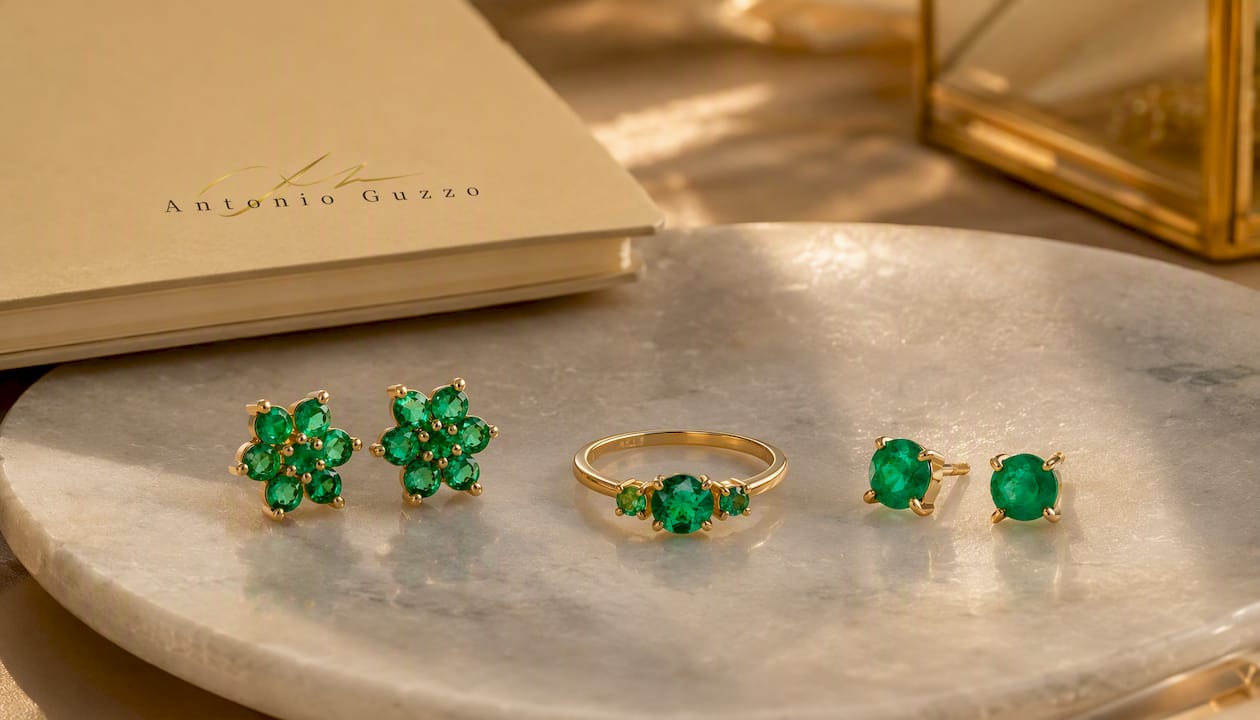
For everyday wear, the Classic Colombian Emerald Stud Earrings in 18K Gold pair a low-profile setting with ethically sourced Colombian stones, so the jardin reads as character rather than risk. Every piece ships with stone details you can ask about directly, including lab documentation where available. Browse the current ring collection to find a setting that matches how you actually plan to wear your emerald.
Sources
FAQ
Are Inclusions in Emeralds a Good Thing?
Inclusions are normal and expected in emeralds, and a total absence of them can actually signal a synthetic stone rather than a flawless natural one. Value depends on whether the inclusions obstruct light or weaken the stone’s structure, not on whether they exist at all.
Why Can’t You Wear Emeralds Every Day?
Emeralds measure 7.5 to 8 on the Mohs hardness scale, but inclusions and internal fractures reduce toughness, making the stone more prone to chipping from impact even though it resists surface scratching. Protective settings like bezels help offset that risk for daily wear.
Can a Jeweler Tell If an Emerald Is Lab-Grown?
A trained jeweler can often spot synthetic emeralds by checking for flattened, geometric gas bubbles, unusually consistent growth zoning, and flux remnants like phenakite crystals under magnification. When the visual signs are ambiguous, a report from a lab like GIA, AGS, or AGL provides a definitive answer.
What Is the Rarest Color of Emerald?
The most prized emeralds show a rich, slightly bluish green with even saturation and enough transparency to let the jardin add character without clouding the stone, a combination most closely associated with fine Colombian material. That specific balance of hue, saturation, and clarity is rare enough that it commands the highest prices in the market.